
Clean heating has a timing problem. Solar heat is abundant in summer, electricity can be cheapest when wind and solar output is high, and industrial facilities often reject useful heat when nearby buildings do not need it. Winter demand arrives months later. A battery can shift electricity by hours, but storing heat directly can be a better match when the final service is warm water, space heating, cooling, or an industrial process.
Seasonal thermal energy storage is the broad idea of banking heat or cold for weeks or months. It can use water, rock, soil, aquifers, phase-change materials, or reversible chemical reactions. The important point is that it is a thermal system, not simply a very large electrical battery. Its value depends on temperature, geology, heat pumps, distribution networks, and the customers that can use the recovered energy.
Store the service instead of converting it twice
Electricity is a flexible, high-quality form of energy. Turning it into heat is easy; turning low-temperature heat back into electricity is difficult and usually inefficient. If the customer ultimately needs heat, storing heat avoids an unnecessary round trip through electricity generation.
The U.S. Department of Energy defines thermal energy storage as keeping energy in a material as a heat source or cold sink for later use. In buildings, it can shift heating or cooling demand away from expensive or grid-constrained hours. Over longer periods, the same principle can move summer heat into winter or winter cold into summer.
This does not make thermal storage universally better than batteries. Electricity storage can serve motors, lights, electronics, and the grid directly. Thermal storage is strongest when a large, predictable thermal load exists close to the store.
Duration changes the engineering
A hot-water tank can shift demand within a day. Ice storage can make cold at night and use it during an afternoon cooling peak. Seasonal storage has a harder job: it must hold a much larger amount of energy while limiting losses over months.
That changes the preferred shape and scale. Heat loss is related to surface area, while stored energy grows with volume. Large stores can therefore retain heat proportionally better than many small ones. District-scale pits, aquifers, and borehole fields can take advantage of this geometry, but they require land, drilling, civil works, and long-term planning.
Our guide to long-duration energy storage makes the same broader point: duration is not a cosmetic specification. It changes which technology, business model, and end use make sense.
Underground storage is several different technologies
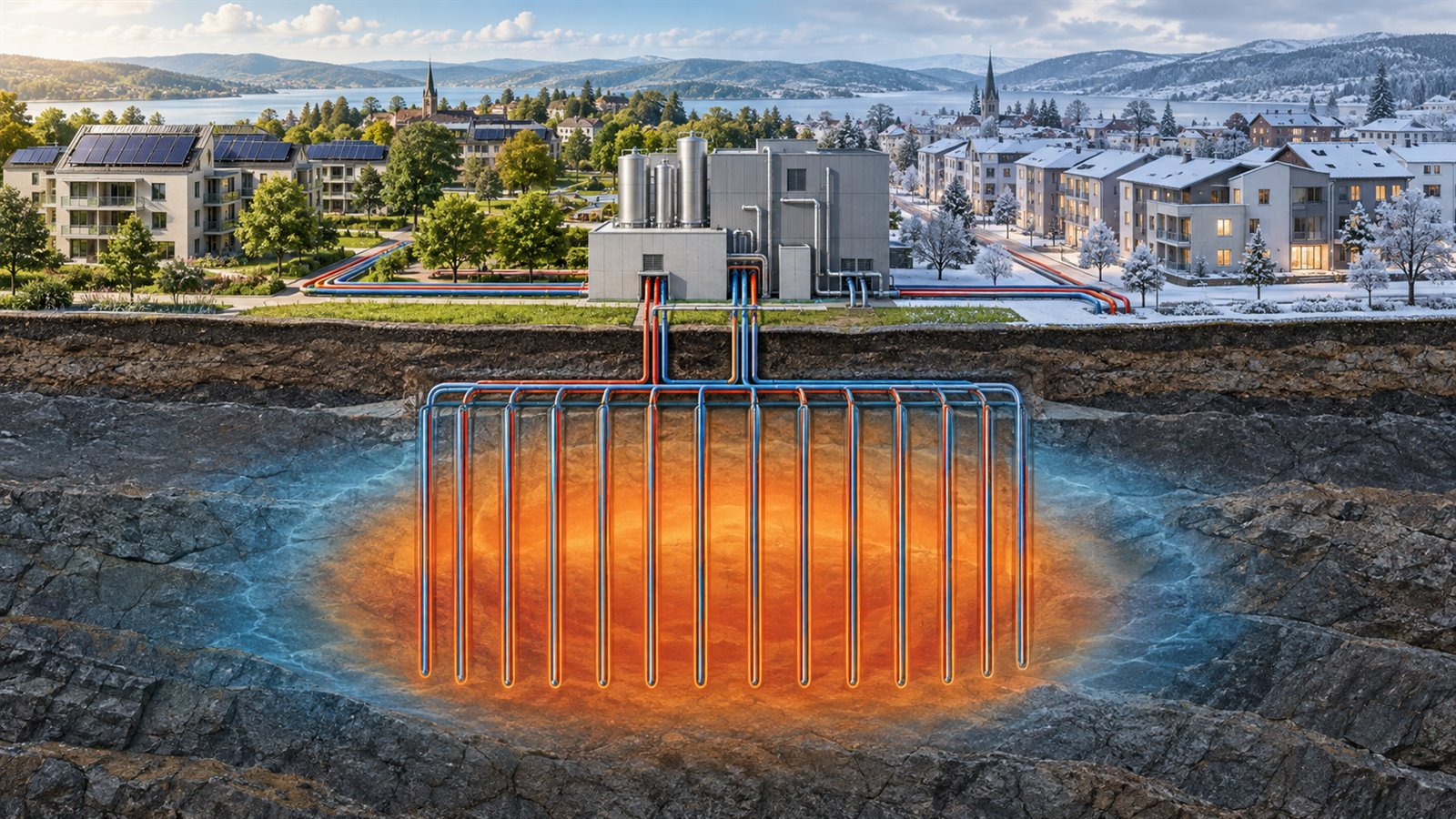
The Department of Energy’s geothermal energy storage overview separates three important underground approaches. Aquifer thermal energy storage, or ATES, circulates groundwater through permeable formations. Borehole thermal energy storage, or BTES, uses closed loops in drilled boreholes and does not depend on moving groundwater through the system. Reservoir thermal energy storage, or RTES, targets deeper formations and higher-temperature applications.
Above-ground options are equally varied. Insulated water tanks and lined pit stores hold sensible heat, meaning their temperature changes as they charge and discharge. Phase-change materials absorb or release energy as they melt and solidify. Thermochemical systems store energy in reversible reactions and may offer higher energy density or low standing losses, but many are less mature.
The DOE’s Thermal Energy Storage Technology Strategy Assessment describes this portfolio rather than one winning design. Water and ice are established; advanced phase-change and thermochemical materials still face questions around cost, cycling, containment, and system integration.
Heat pumps make stored temperatures more useful
A seasonal store does not always need to emerge at the exact delivery temperature. A heat pump can raise the recovered heat to the level required by a building or network. The warmer and more stable source can also help the heat pump operate more effectively than it would against very cold outdoor air.
That relationship makes charging temperature, discharge temperature, and heat-pump performance part of one design. Storing heat at a higher temperature can increase losses and demand more expensive materials. Storing it cooler may preserve energy but require more electricity during discharge. Engineers must optimize the whole annual cycle, not one impressive temperature number.
The same system logic applies to industrial heat pumps: a machine’s maximum outlet temperature says little without the source temperature, required lift, operating hours, and process integration.
District energy creates the missing network
Large seasonal stores need enough connected demand to justify their size. District heating and cooling networks provide that aggregation. The International Energy Agency’s 2026 report Renewables in District Energy says such networks already serve around 600 million people, while many systems still depend heavily on fossil fuels. It identifies geothermal, solar thermal, recovered heat, large heat pumps, and thermal storage as routes to cleaner operation.
A network can collect heat from sources that would be too intermittent or dispersed for a single building. Data centers, wastewater, industrial processes, solar collectors, and electric heat pumps can charge shared storage. The store can then reduce peak boiler use and allow heat production to run when energy is available rather than exactly when customers open a tap.
Thermal storage can help the electricity grid indirectly
When a heat pump or electric boiler charges storage during periods of abundant electricity, the heating system becomes a flexible load. It can reduce consumption during a grid peak without making buildings cold because the thermal store continues supplying the network.
This resembles a virtual power plant, but the controllable asset is heat production and storage rather than only an electrical battery. The European Commission’s Joint Research Centre notes in its thermal storage technology assessment that power-to-heat plus storage can decouple electricity consumption from immediate heating demand and support more variable renewable generation.
The benefit is conditional. A store cannot respond faster than its pumps, controls, network, and customer constraints allow. Grid services also require metering, communications, market access, and a baseline against which flexibility can be measured.
Efficiency is an annual system result
Thermal stores are sometimes described with a single round-trip efficiency, but that number can hide important boundaries. Does it include pumping electricity, heat-pump input, distribution losses, auxiliary boilers, and heat remaining in the ground at season’s end? Is the recovered heat at a useful temperature?
A fair comparison tracks delivered heat across an annual cycle. It should include standing losses, charge and discharge temperatures, flow rates, heat-pump coefficient of performance, network return temperature, and parasitic electricity. Exergy, a measure of how useful energy is at a given temperature, also matters: very hot energy is wasted if the customer only needs lukewarm water.
Geology and permits can decide the project
ATES needs a suitable aquifer and careful groundwater management. BTES avoids open groundwater circulation but requires enough drillable land and acceptable spacing between boreholes. Deeper reservoir systems add subsurface uncertainty, well cost, and monitoring requirements. Pit storage needs a large excavation, durable liners, insulation, and water management.
Projects must consider thermal movement beyond the property, groundwater protection, existing wells, underground utilities, and the possibility that neighboring systems interfere with one another. Early site characterization is not paperwork added after the technology choice; it determines which technology is possible.
Limitations and what to watch next
Seasonal thermal storage is infrastructure-heavy and location-specific. It works best with dense, durable heat demand and a network that can accept lower temperatures. Retrofitting old steam systems, financing drilling, coordinating many building owners, and assigning subsurface rights can be harder than the storage physics.
Watch for better field data on multi-year thermal recovery, wider use of low-temperature district networks, and validated thermochemical systems that retain energy with smaller standing losses. Also watch for projects that combine cooling, heating, and grid flexibility rather than valuing each service separately. The winning designs will be measured by reliable heat delivered over years, not by storage capacity alone.
Featured image: AI-generated editorial illustration of a district energy system and borehole thermal store. It does not depict a specific project or hands-on test.
Primary and authoritative sources
- U.S. Department of Energy: Geothermal Energy Storage
- U.S. Department of Energy: Thermal Energy Storage
- International Energy Agency: Renewables in District Energy
- U.S. Department of Energy: Thermal Energy Storage Technology Strategy Assessment
- European Commission Joint Research Centre: Novel Thermal Energy Storage in the European Union
Leave a Reply