
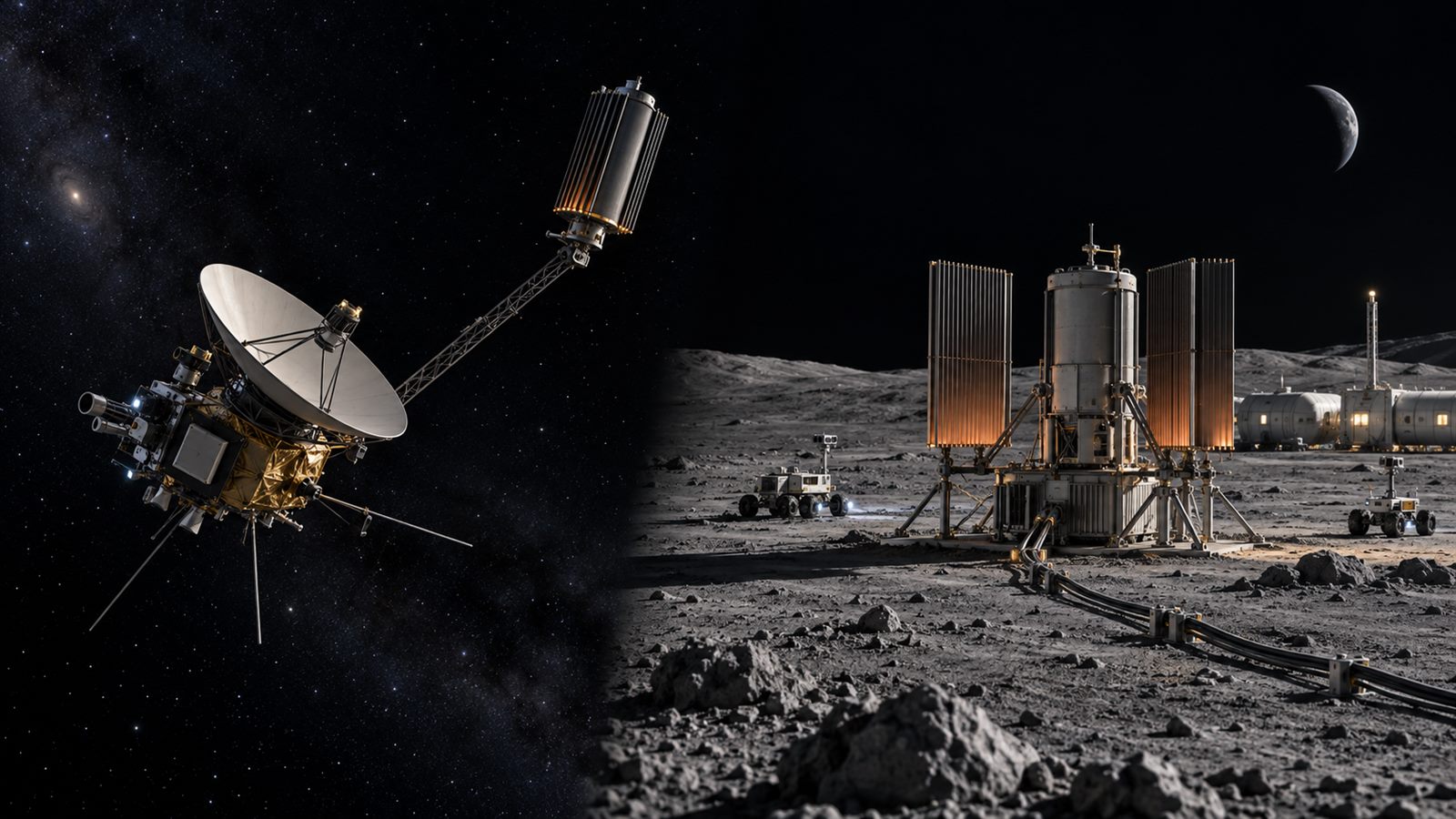
Space nuclear power is often discussed as if it were one technology. It is not. A radioisotope thermoelectric generator, or RTG, quietly converts heat from natural radioactive decay into a modest flow of electricity. A fission reactor controls a chain reaction to produce far more heat and potentially far more electrical power. Both contain nuclear material, but they serve different missions and create different engineering problems.
That distinction matters as robotic probes travel farther from the Sun and agencies study longer operations on the Moon and Mars. Choosing a power source affects instruments, communications, thermal control, surface layout, safety analysis, fuel supply, and the amount of useful work a mission can perform.
An RTG is a passive heat source with an electrical converter
An RTG does not contain a nuclear reactor and does not sustain a chain reaction. Its plutonium-238 fuel produces heat through natural radioactive decay. Thermocouples convert part of the temperature difference between the hot fuel and the colder surroundings into electricity.
NASA’s radioisotope power overview notes that RTGs have no moving parts. The current Multi-Mission Radioisotope Thermoelectric Generator supplies both electricity and useful heat to the Curiosity and Perseverance rovers. Similar systems have supported missions including Voyager and New Horizons, where sunlight is weak and maintenance is impossible.
Radioisotope heater units are smaller relatives. They use tiny fuel pellets to warm instruments and mechanisms without serving as the spacecraft’s main electrical generator. Keeping a valve, battery, or electronics box warm can be as mission-critical as generating power.
A fission system actively manages a chain reaction
A fission reactor releases heat by splitting atomic nuclei in a controlled chain reaction. It requires reactor control, heat transport, power conversion, electrical conditioning, and heat rejection. Those extra systems add complexity, but they make much higher output possible.
NASA’s Fission Surface Power project is working with the Department of Energy and industry on a 40-kilowatt-class system for lunar operation in the early 2030s. The goal is continuous surface power that does not depend on local sunlight or weather. That scale is intended for habitats, rovers, experiments, resource processing, and other sustained activities rather than a single low-power science probe.
The first difference is the power budget
RTGs are excellent when a spacecraft needs dependable power measured in hundreds of watts or less over many years. That is enough for carefully managed computers, heaters, radios, and scientific instruments, but it imposes strict schedules. A spacecraft may turn instruments on one at a time, store data, and wait for enough available power to transmit.
A surface reactor targets tens of kilowatts and can support simultaneous loads. More power allows stronger communications, active thermal control, larger tools, and energy-intensive processing. It also creates a distribution problem: cables, switches, converters, redundancy, fault isolation, and load priorities become a small electrical grid.
The same systems view appears in our discussion of lunar communications and navigation. A base needs dependable services, not a collection of isolated demonstrations.
Heat is both the resource and the constraint
Nuclear systems start with heat. An RTG converts only part of it into electricity, and a spacecraft must manage the remainder. In a cold environment that waste heat can keep electronics and mechanical parts within their operating range. Elsewhere it may disturb sensitive instruments or force designers to use insulation, conductive paths, and careful placement.
A higher-power reactor produces much more waste heat. In space, there is no air to carry it away by convection, so radiators must emit it as infrared radiation. Radiator area, orientation, temperature, and protection from dust or damage become major design choices. A compact reactor core does not automatically produce a compact power station.
Solar power remains the simpler answer in many places
Nuclear power is not automatically superior to solar arrays and batteries. Near the Sun, solar systems can provide large amounts of power without nuclear fuel or a nuclear launch review. Their performance, cost, and mission heritage make them the default for many spacecraft.
The balance changes where sunlight is weak, dust reduces output, or darkness lasts too long for practical battery storage. The lunar night lasts roughly two Earth weeks at many locations, while permanently shadowed regions receive no direct sunlight. Deep-space probes also face a solar intensity that falls rapidly with distance from the Sun.
This is a mission architecture choice, similar to the tradeoffs behind space-based solar power. The generator cannot be evaluated separately from storage, wiring, thermal control, deployment, and operations.
Surface reactors change the layout of a base
A lunar reactor would not simply sit beside a habitat like a household generator. Planners must choose distance and terrain that help manage radiation exposure while limiting cable mass and electrical losses. Berms or local regolith may contribute shielding, but moving material requires equipment and power. Deployment robots must place components, connect cables, verify operation, and recover from faults.
Dust makes that work harder. Connectors, radiators, mechanisms, and optical inspection all face the abrasive, electrostatic material described in our article on lunar dust systems engineering. Redundant power paths are valuable, but every extra connector and cable introduces another item to deploy and protect.
Fuel and manufacturing capacity shape mission choices
Plutonium-238 is specialized material, not ordinary reactor fuel. The U.S. Department of Energy maintains the facilities and expertise needed to purify and encapsulate the isotope, build heat sources, integrate power systems, test them, and analyze safety. That supply chain limits how many radioisotope systems can be produced and makes each unit a strategic mission resource.
Fission systems use different fuel and manufacturing processes, but they also need qualified materials, converters, controls, test facilities, and specialized personnel. A flight design must survive launch vibration and then operate after years of storage and transit. Ground testing has to reproduce critical behavior without pretending that every aspect of a lunar deployment can be tested on Earth.
Launch safety is part of the design from the beginning
Space nuclear systems are designed around accident conditions as well as normal operation. Fuel form, containment, impact protection, launch vehicle trajectory, possible reentry, and emergency response all influence the safety case. The question is not whether a launch can have an accident, but how the system contains material and how risk is analyzed across credible scenarios.
NASA’s revised NPR 8715.26A, effective in 2026, requires programs anticipating the launch or return of radioactive material to categorize the flight and identify applicable nuclear safety requirements. It also calls for safety-in-design, documented roles, mission-specific analysis, and launch authorization planning. The process covers both radioisotope systems and fission reactors, but requirements are tailored to the mission and potential hazard.
Power and propulsion are separate questions
A surface reactor makes electricity. An RTG makes electricity and heat. Neither automatically propels a spacecraft. Nuclear thermal propulsion would use reactor heat to accelerate propellant, while nuclear electric propulsion would use electrical power to run an electric thruster. Those concepts have different temperatures, operating times, materials, and safety considerations.
Keeping the terms separate prevents an easy misunderstanding: a mission can use nuclear power without using nuclear propulsion, and a high-performance propulsion reactor is not automatically suitable for supplying a surface base.
Limitations and what to watch next
RTGs offer exceptional longevity, but their electrical output is limited and gradually declines. Fission systems can deliver much more power, but require controls, conversion machinery, radiators, deployment, and a larger safety and operations framework. Neither eliminates the need for batteries, because spacecraft still need to handle short power peaks, startup sequences, and faults.
Watch for NASA and DOE testing of surface-power components, progress on long-life power conversion and radiators, clearer lunar deployment plans, and continued work on radioisotope fuel and generator production. The useful comparison is not nuclear versus non-nuclear in the abstract. It is whether a complete power architecture can safely meet a specific mission’s load, environment, lifetime, and failure requirements.
Featured image: AI-generated editorial comparison of a deep-space probe using an RTG and a lunar outpost using a fission surface power system. It is not a rendering of a selected flight design or a hands-on test.
Leave a Reply