
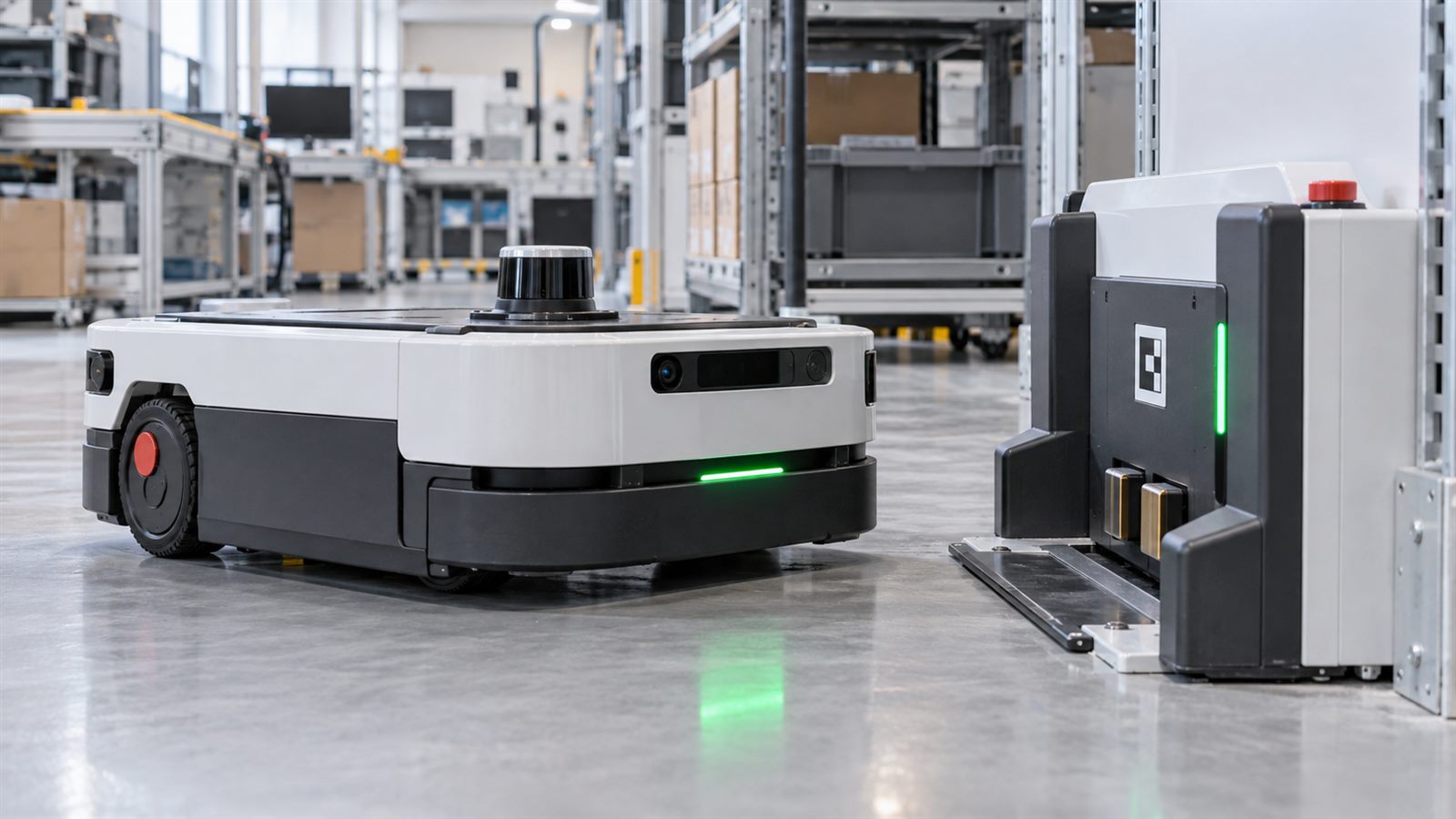
An autonomous mobile robot can navigate a warehouse aisle beautifully and still spend its last few minutes of battery life nudging a charger without making electrical contact. The trip to the charger and the final centimeters of docking are different engineering problems. A reliable robot must decide when to return, reach a staging position, locate the dock precisely, make contact, confirm charging, and recover when any step fails.
That is why battery capacity alone does not determine useful operating time. A larger pack may extend a shift, but an unreliable return-to-charge cycle can still strand a machine or demand frequent human intervention. For buyers and curious observers, the better question is not simply how long a robot runs. It is how consistently it can resume work after a complete charge-and-undock cycle.
Getting near the dock is not the same as docking
A navigation system can bring the robot to a waypoint near its charger. At that point, the tolerances usually become tighter than those of ordinary travel. The robot may need to align a connector, contact pads, or a mechanical interface while avoiding a hard collision. A map location can be slightly wrong; the charger can move; wheels can slip on a dusty or uneven floor.
The Nav2 Docking Server tutorial separates the process into navigating to a staging pose, detecting and refining the dock pose, controlling the final approach, detecting contact, and waiting for charging to start. That sequence matters because each step has a different failure mode. Our earlier explanation of robot map drift and localization covers why a global map alone is a weak guide for a precise final maneuver.
Local sensing closes the final-position gap
Near the dock, a robot can use a camera, fiducial marker, lidar, proximity sensor, or other local measurement to refine where the charger actually is. It then approaches slowly under feedback control rather than assuming that the mapped coordinate is exact. Nav2’s example uses a detected dock pose and can receive battery and motor-state information, but those inputs depend on the particular robot and dock hardware.
Local sensing does not eliminate uncertainty. A marker can be hidden by a box, lighting can change, a reflective surface can confuse a sensor, and a docking area can be obstructed by people or equipment. Even a well-localized robot may be unable to approach safely from the required angle. The system needs a way to pause, retry within limits, or ask for help instead of pushing indefinitely.
Physical contact is not proof of charging
Touching the dock is only a mechanical event. Charging is an electrical state. Misaligned contacts, dirt, a disabled charger, or a battery-management fault can leave a robot parked against the station without receiving energy. A docking controller should therefore distinguish at least three outcomes: it reached the intended position, it made contact, and the battery system confirms that charging began.
Nav2’s docking interface explicitly distinguishes isDocked from isCharging, and its workflow waits for charging confirmation where applicable. Its configurable timeouts and retries also show that success is a monitored process, not a single arrival event. A robot may be visibly parked yet still need to back away and attempt a new approach.
The underlying battery telemetry matters as much as the maneuver. The ROS 2 battery-state broadcaster documentation describes reporting voltage and, when available, current, temperature, charge, and percentage. Some fields can be unmeasured. A fleet manager should not treat a missing reading as proof of a healthy charge, and operators need to know which signals a particular robot actually provides.
Return-to-charge is a scheduling decision
A robot should not start a long delivery simply because its battery indicator is above a fixed percentage. It needs enough energy for the assigned route, possible delays, the return trip, and the final docking attempt. Payload, floor conditions, speed, sensor use, and battery aging all affect the margin. In a fleet, a robot also needs an available station when it arrives.
This is where task allocation and charging policy meet. A fleet can reserve a charger, stagger returns so multiple robots do not queue at one station, and hold a low-battery robot out of new assignments. The details depend on the facility; no universal percentage threshold works everywhere. The broader integration issue resembles the one in mixed robot fleets: successful operation depends on shared information about jobs, status, and infrastructure, not only the vehicle’s navigation software.
Measure complete-cycle reliability, not a polished demo
A one-time successful docking video is useful evidence that a maneuver is possible. It says little about performance across different starting points, loads, floor conditions, and repeated shifts. The buyer-relevant metric is the proportion of complete cycles that end in verified charging and later successful undocking without an operator’s help. Time spent recovering and time lost waiting for a charger matter too.
ASTM F3499-21 defines a test method for confirming the docking performance of autonomous unmanned ground vehicles. Its published scope focuses on positioning and repeatability at a dock from one or more start locations. NIST’s mobile-robot performance work also identifies docking and weighted driving among the scenarios that need repeatable methods. These sources support a disciplined test plan, but a position test alone does not prove that electrical charging, charger availability, and fleet scheduling all work together.
A practical evaluation would record approach attempts, contact detection, confirmed charging, charge duration, interruptions, undocking, and the next completed task. It should disclose the test environment and repeat trials after small changes to dock placement or floor conditions. Those are proposed evaluation questions, not results from hands-on tests of any particular product.
Failure recovery should be predictable
When docking fails, the robot needs a bounded response: stop safely, move to a clear retry position if possible, re-detect the dock, and try again only a limited number of times. If it cannot establish charging, it should report the reason it knows, such as lost dock detection or missing charge confirmation, and preserve enough battery to await assistance. Silent failure is especially damaging because operators may assume a parked robot is preparing for its next job.
Maintenance is part of this reliability story. Contacts wear or collect debris, markers become occluded, a charger can lose power, and software updates can change approach behavior. A robust system makes those faults visible in logs and routine checks. It also treats docking as an application-level safety problem: people and other robots may be near a station even when the approach speed is low. See our discussion of robot safety at the application level.
What remains difficult
There is no single charger geometry, sensor package, or battery-management interface shared by all mobile robots. A software framework can standardize the sequence, but hardware-specific detection and charge verification still need integration and validation. A system that works with an unobstructed laboratory dock may behave differently in a busy warehouse. Published standards can define repeatable positioning tests, yet real uptime also depends on charging electronics, maintenance, network availability, and scheduling.
For ordinary users, that means claims of “autonomous charging” need context. Ask whether the robot merely returns to a location, whether it confirms power transfer, how it handles a blocked charger, and how often someone must intervene over many cycles. Published specifications alone cannot answer all of those questions.
What to watch next
Watch for evaluations that report full charging-cycle success under varied starting positions and realistic disturbances, not just approach accuracy. More useful fleet tools would show charger occupancy, battery telemetry quality, failed attempts, and expected task availability in one place. Better interoperability could make charging policy less tied to a single robot brand, while standardized tests could make reliability claims easier to compare.
The strongest mobile-robot deployments will treat charging as part of the work cycle rather than an afterthought. A robot that can return, connect, verify energy flow, recover from a failed attempt, and rejoin the schedule is more useful than one that simply carries a larger battery.
Primary and authoritative sources
- Nav2: Using Docking Server
- Nav2: Docking Server configuration
- ROS 2 Control: Battery State Broadcaster
- ASTM F3499-21 docking performance test method
- NIST: Mobility Performance of Robotic Systems
Featured image is an AI-generated editorial illustration, not a photograph of a specific commercial robot or charger.
Leave a Reply