
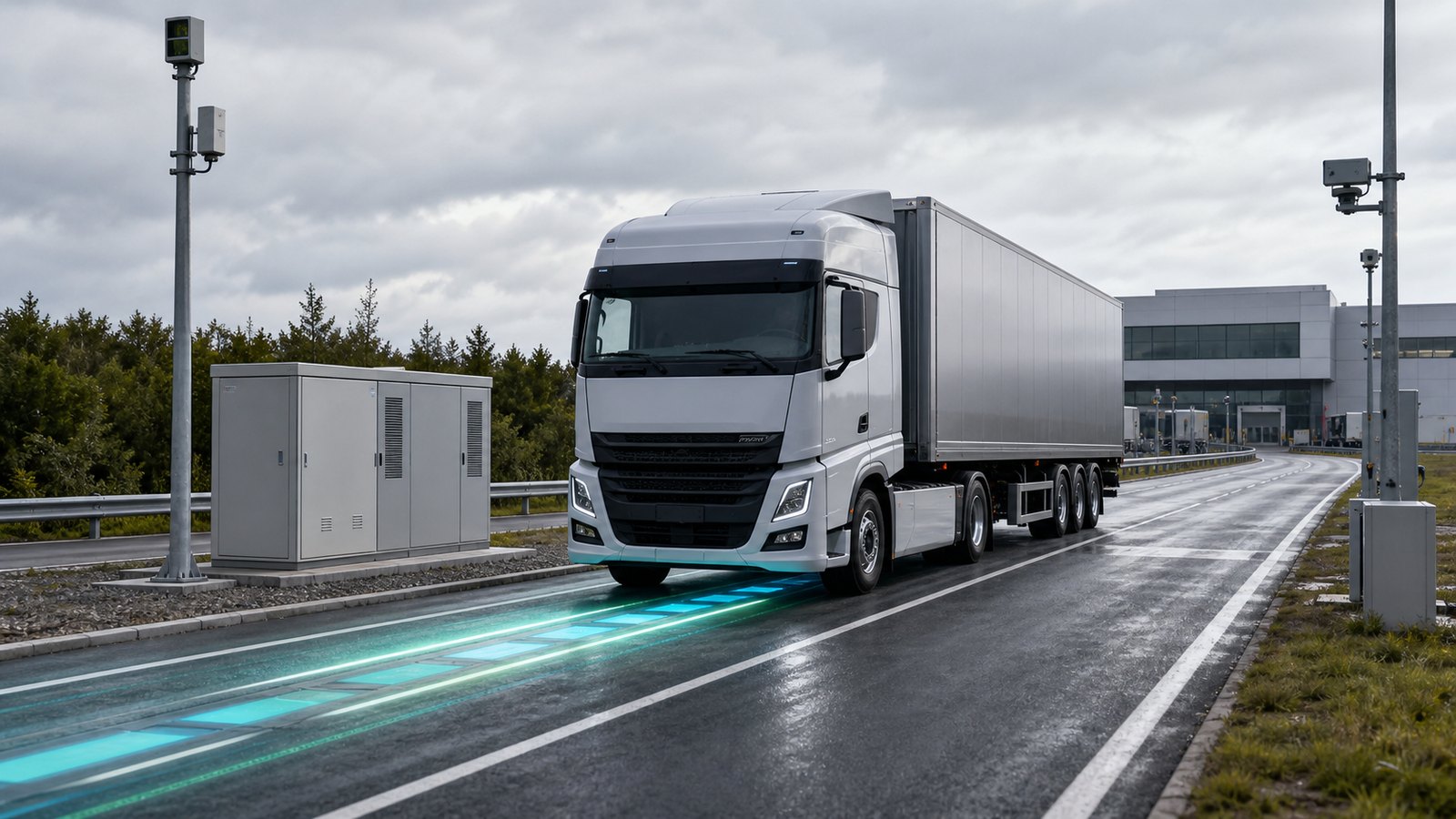
Electric road systems sound like a futuristic shortcut: build charging into the road, let trucks draw power while moving, and reduce the need for huge batteries or long charging stops. The idea is technically real, and several countries have tested versions of it. But the next phase is less about wonder and more about standards, economics, maintenance, and whether freight corridors can attract enough users to justify the infrastructure.
For future transportation, electric roads are worth watching because they sit between two competing strategies. One strategy says battery-electric trucks should carry enough energy and use megawatt chargers during scheduled stops. The other says the road itself can become part of the charging system, especially for high-use freight lanes. The likely answer may not be either-or. Electric roads could make sense in dense corridors while depot charging and fast charging handle most routes.
How an electric road works
An electric road system, or ERS, transfers energy from infrastructure to a vehicle while it is parked or moving. Several approaches exist. Overhead catenary wires can power trucks equipped with a pantograph, similar in spirit to electric rail. Conductive rails can sit in or on the road surface and connect to a pickup under the vehicle. Inductive systems use embedded coils to transfer power wirelessly. Each approach changes vehicle design, road maintenance, safety rules, and cost.
The appeal is straightforward. If a truck can charge during part of its route, it may need a smaller battery, carry more payload, stop less often, or reduce stress on depot charging. That could be valuable for long-haul freight, ports, mining corridors, and shuttle routes where vehicles repeat the same path many times. It also connects to the infrastructure questions raised in Megawatt Charging for Heavy Electric Trucks: the vehicle is only half the system.
The standardization problem
Electric roads are only useful if vehicles and infrastructure can work across suppliers and borders. A truck operator does not want one pickup system for Sweden, another for France, and another for a private logistics park. That is why technical specifications such as CLC/TS 50740, which covers ground-based feeding systems for dynamic electric road charging infrastructure, are important. They help turn pilots into interoperable infrastructure rather than isolated demonstrations.
Interoperability is especially important in Europe because freight corridors cross national borders. A technology that works on one test segment may not justify vehicle investment unless operators can see a larger network forming. The European Commission’s road-charging framework is also relevant because electric road business models may depend on how infrastructure costs are recovered, how users are billed, and how cross-border corridors are financed.
Why Sweden’s pause matters
Sweden has been one of the most visible electric-road testbeds. Trafikverket, the Swedish Transport Administration, selected the E20 section between Hallsberg and Orebro as the planned route for a permanent electric road, with the aim of reducing freight emissions. But the project was later paused after cost and procurement realities proved difficult. That does not mean electric roads are dead. It means the technology must survive the same scrutiny as bridges, substations, highways, and charging depots.
This is a useful lesson for technology fans. A pilot can prove that vehicles can receive power from a road. A national infrastructure program must prove much more: construction cost, winter durability, maintenance disruption, billing systems, supplier competition, grid connection, vehicle availability, safety certification, and utilization. If the road is expensive but only a small fleet can use it, the economics weaken quickly.
Where electric roads may fit best
The strongest early use cases are likely controlled or high-density routes. Ports, industrial corridors, airport logistics loops, bus rapid transit routes, mining roads, and distribution lanes may have enough repeated traffic to justify specialized infrastructure. These settings also make maintenance and vehicle compatibility easier to manage. A public long-haul corridor is harder because it must serve many operators and vehicle types over many years.
Electric roads could also work as part of a layered charging strategy. Depot charging covers vehicles that return home. Public fast charging covers rest stops and route flexibility. Electric-road segments reduce peak battery demand on the most predictable high-volume lanes. That layered model resembles other infrastructure transitions: the future is rarely one technology replacing all others overnight.
Limitations for ordinary drivers
Passenger cars are not the main reason to watch ERS. Most private drivers can charge at home, at work, or at public stations, and they do not travel the same freight corridor all day. Heavy trucks are different because battery mass, charging time, payload, and route economics are more demanding. That is why electric roads are best understood as freight infrastructure first.
Safety and maintenance are also real concerns. Road surfaces face water, salt, snow, debris, crashes, resurfacing, and heavy axle loads. Any system embedded in the pavement must be safe for motorcycles, pedestrians, emergency vehicles, snowplows, and repair crews. Wireless systems avoid some contact issues but may be more expensive or less efficient. Conductive systems may transfer higher power but create more direct infrastructure interaction. Overhead wires are mature but fit only certain vehicle classes and routes.
What to watch next
Watch whether electric-road pilots move from demonstrations to corridor economics. The key signs are interoperable standards, multiple suppliers, clear billing, public cost estimates, grid plans, and committed fleets. Also watch how ERS compares with battery improvements, depot charging software, and megawatt charging networks. If batteries get cheaper and charging stations scale quickly, the economic case for road-powered corridors becomes narrower. If grid constraints and charging queues slow heavy-truck electrification, ERS may look more attractive in selected places.
The broader future-transportation lesson is that electrification is an infrastructure problem, not only a vehicle problem. The same is true for over-the-air vehicle updates and automated rail inspection systems: software, standards, safety, and maintenance decide whether promising transport ideas become dependable public systems. Electric roads are no exception.
Sources: Trafikverket E20 electric road project; CLC/TS 50740:2025 electric road charging specification listing; European Commission road charging framework.
Leave a Reply