
Quantum sensors are often introduced with one irresistible promise: they can detect signals that conventional instruments miss. That is true in important cases, but it is not a universal upgrade. A sensor that excels at the faintest magnetic field may require shielding or cooling. Another may survive harsh conditions but give up some sensitivity. A third may measure acceleration with exquisite stability while demanding lasers, vacuum hardware, and careful vibration control.
The practical question is therefore not whether a sensor is quantum. It is whether its complete measurement system delivers the right sensitivity, range, speed, resolution, stability, and reliability for a particular job. Quantum physics can improve one or more of those metrics, but engineering determines whether the advantage survives outside the laboratory.
A quantum sensor is a measurement architecture
A quantum sensor uses a controlled quantum property of matter or light to infer a physical quantity. According to NIST’s quantum sensing overview, examples include atomic clocks, magnetometers based on atomic spin or superconductivity, single-photon detectors, atom interferometers, electric-field sensors, and squeezed-light instruments.
The sensing element is only the center of the architecture. Lasers prepare and read atomic states. Microwave sources manipulate spins. Photodetectors convert light into electrical signals. Control software estimates a quantity from noisy data. Enclosures manage temperature, vibration, stray fields, and contamination. Packaging, power, and communications decide whether the instrument can leave a specialist laboratory.
This is similar to the broader shift described in quantum hardware manufacturing: performance depends on repeatable subsystems and interfaces, not only on an impressive device demonstrated once.
Sensitivity is only one line on the specification sheet
Sensitivity describes how small a change can be detected under stated conditions, usually over a defined bandwidth and integration time. It is not the same as accuracy, which concerns closeness to the true value. Nor is it resolution, repeatability, long-term stability, spatial resolution, or immunity to interference.
A very sensitive instrument can still be unsuitable if its useful range is narrow, its response is slow, or its reading drifts when temperature changes. Longer averaging can reveal weaker signals, but that may hide fast events. Increasing interaction time can improve precision, yet also make the quantum state more vulnerable to environmental noise. Every published sensitivity number needs context: frequency, measurement time, operating temperature, geometry, and the noise conditions under which it was obtained.
Magnetometers make the tradeoffs visible
NIST’s comparison of quantum magnetometers shows why no single platform wins every application. Superconducting quantum interference devices, or SQUIDs, are exceptionally sensitive and support uses from brain imaging to materials research. Their superconducting circuits, however, require cryogenic refrigeration, which adds cost, mass, and operational complexity.
Atomic vapor magnetometers use laser light to prepare and read the spins of atoms in a glass cell. They can approach SQUID-class sensitivity while operating near room temperature, which makes portable biomedical and geophysical instruments more plausible. But they still need stable optical control and protection from unwanted magnetic fields.
Diamond nitrogen-vacancy, or NV-center, sensors offer another balance. The sensing defects are embedded in durable diamond, can work over broad temperature and pressure conditions, and can provide nanoscale magnetic images. NIST notes that the best NV magnetometers have not matched the weakest-field sensitivity of leading atomic and SQUID systems, but they handle high-frequency fields and a wide range of field strengths well. That can be the better capability for chip inspection, microscopy, or rugged navigation experiments.
Bandwidth and dynamic range decide what can be observed
A sensor must respond on the time scale of the phenomenon. A device optimized to average a nearly constant field for minutes is different from one designed to capture radio-frequency changes. Likewise, dynamic range determines whether the instrument can distinguish a tiny variation without saturating when the background is large.
A 2025 NIST review of atom-based electromagnetic sensing covers vapor-cell, NV-center, and Rydberg-atom modalities spanning direct-current fields through terahertz frequencies and spatial scales from nanometers to meters. That range is evidence of specialization, not interchangeability. Buyers should compare performance in the frequency band, geometry, and field strength that their application actually uses.
The environment becomes part of the instrument
Quantum states are useful because they respond to small disturbances. The same fact makes them respond to disturbances that are not the target signal. Stray magnetic fields, laser-frequency noise, vibration, temperature gradients, and mechanical motion can all appear in the output unless the instrument suppresses or models them.
Atom interferometers illustrate the point. They split and recombine matter waves so that gravity, acceleration, or rotation changes the interference pattern. NIST describes potential applications in gravimetry and navigation, but the apparatus relies on cooled atoms, controlled laser pulses, and a stable measurement reference. The sensor does not remove vibration and platform motion from the world; the system must separate those effects from the quantity being measured.
An atomic reference does not validate the whole device
Atoms of the same isotope have reproducible energy levels, giving many quantum sensors an intrinsic and highly consistent reference. That is one reason optical clocks can support a future redefinition of the second.
However, a complete field instrument also contains optics, electronics, geometry, algorithms, and environmental compensation. Those components can introduce offsets and uncertainty. Traceability therefore requires an uncertainty budget and comparisons against trusted standards, not simply a statement that the sensing element is atomic. Self-referencing can reduce calibration burden without making validation unnecessary.
Field deployment is an engineering program
The U.S. National Quantum Initiative’s strategy for bringing quantum sensors to fruition emphasizes testing prototypes with end users and developing enabling components such as compact, reliable lasers and integrated optics. Those recommendations recognize that laboratory sensitivity is only one step toward a deployable product.
A field system must start reliably, survive transport, maintain alignment, reject interference, report its health, and recover from ordinary faults. It also needs a useful size, weight, power draw, maintenance interval, and cost. In many applications the best design will combine a quantum sensor with classical inertial sensors, magnetic sensors, timing references, or statistical filters. The classical system supplies continuity and range; the quantum channel supplies a precise correction or reference.
How to evaluate a quantum sensing claim
Begin with the quantity being measured and the decision the measurement supports. Then ask for sensitivity and accuracy over the required bandwidth, dynamic range, spatial resolution, warm-up time, and long-term drift. Check whether the quoted result was obtained in shielding, vacuum, or cryogenic conditions and whether those conditions exist in the intended deployment.
Look for comparisons against the best relevant classical instrument, not against an outdated baseline. Ask whether the result covers the sensing element alone or the complete packaged system. Independent repeatability, uncertainty analysis, and field trials matter more than the word quantum on a product page. The same discipline applies to quantum random-number generators, where certification must evaluate the whole source and its failure behavior.
Limitations and what to watch next
Quantum sensors will not replace inexpensive classical sensors where existing performance is already sufficient. Some platforms remain research instruments, and even mature quantum devices can depend on costly support equipment. Security-sensitive navigation claims also require testing against spoofing, magnetic anomalies, map errors, and deliberate interference; a sensitive detector alone does not create a trustworthy navigation service.
Watch for integrated photonics, smaller laser and vacuum packages, better magnetic shielding, robust calibration procedures, and published field comparisons using common metrics. The most important progress may look less dramatic than a record sensitivity number: a sensor that operates for months, reports honest uncertainty, and solves one measurement problem better than the complete classical alternative.
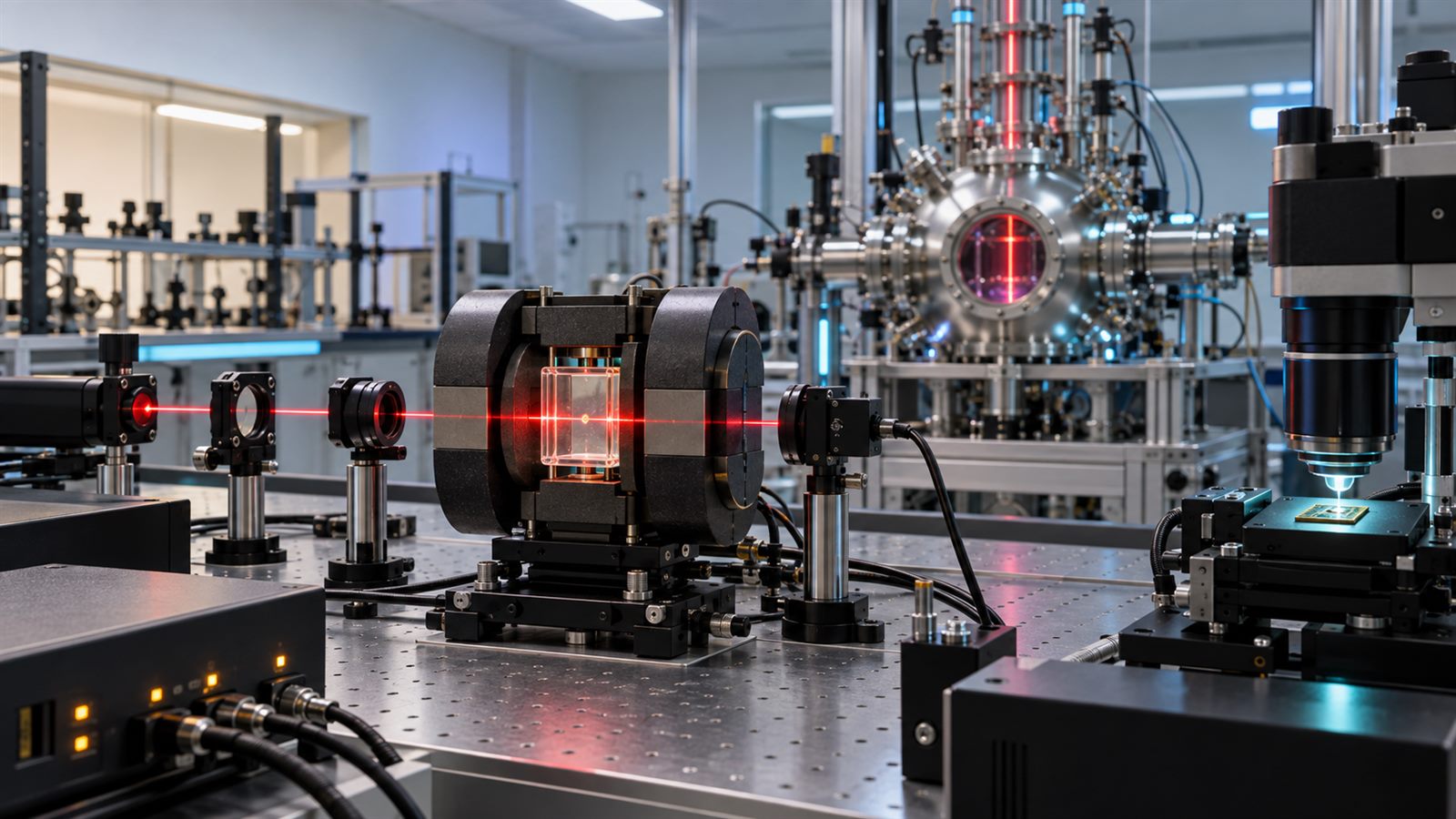
Featured image: AI-generated editorial visualization of several quantum sensing platforms in a precision laboratory. It is not a photograph of a specific experiment or a hands-on product test.
Leave a Reply