
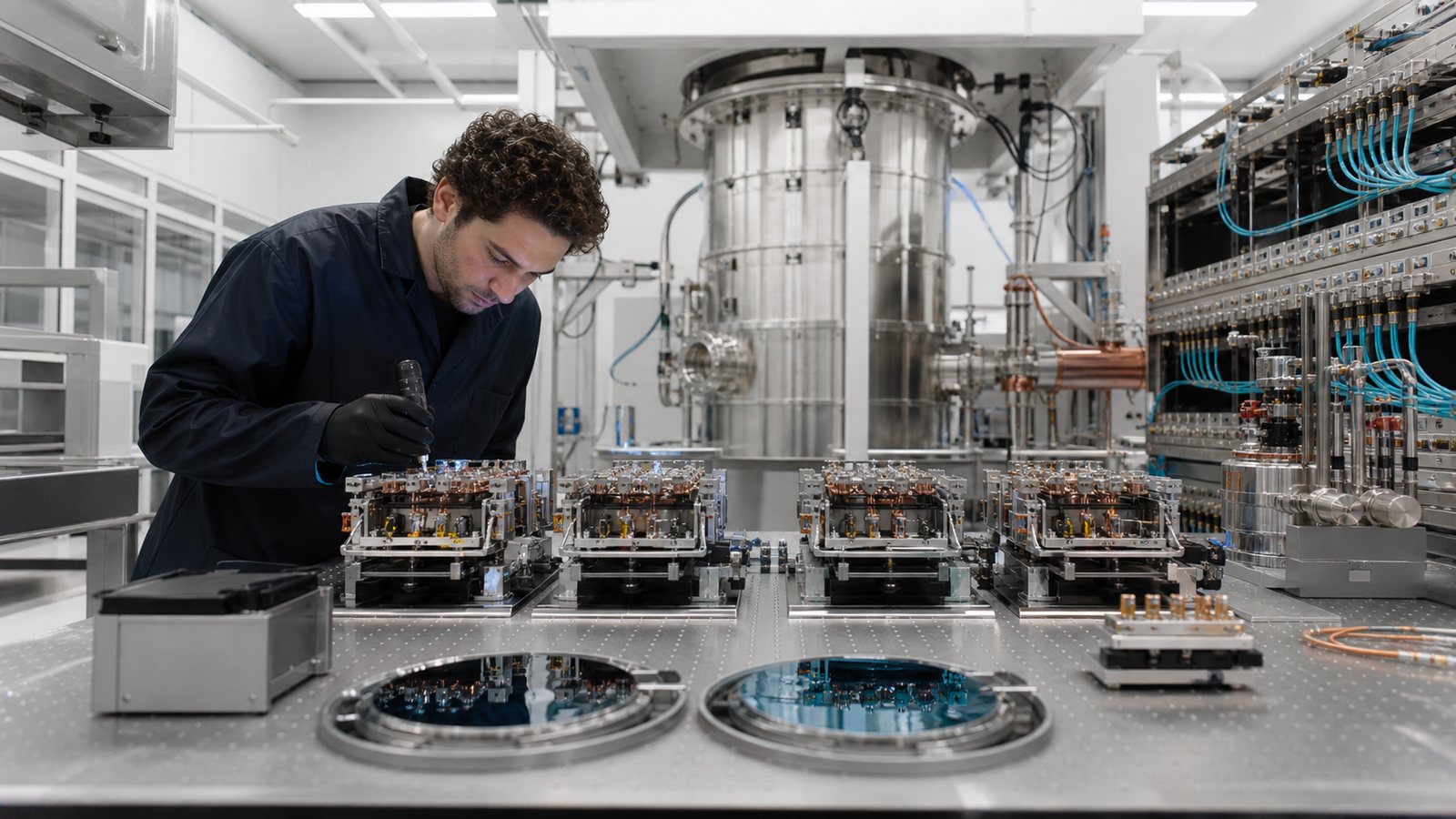
A quantum processor can produce an impressive laboratory result and still be difficult to build twice. The physical device may depend on custom fabrication, hand-selected components, delicate packaging, specialized lasers, ultra-low-temperature equipment, and calibration performed by the people who designed it. That is enough for research. It is not yet a manufacturing system.
The next phase of quantum technology is therefore as much about manufacturing engineering as quantum physics. In June 2026, the US National Institute of Standards and Technology announced a Quantum Manufacturing Engineering Center intended to address barriers to scalable components and systems. The shift matters because useful quantum computers, sensors, and communications equipment need repeatable production, measurable quality, repairable supply chains, and specifications that customers can compare.
A Working Prototype Is Not a Production Process
Research teams optimize for discovery. They may change a material stack, optical path, control circuit, or cryogenic assembly whenever an experiment suggests an improvement. Manufacturing optimizes a different set of outcomes: yield, repeatability, traceability, throughput, cost, serviceability, and predictable performance across units.
That transition is hard because quantum systems amplify small variations. Surface contamination, film thickness, alignment, vibration, magnetic fields, temperature gradients, connector loss, or laser noise can alter device performance. A process that succeeds in the hands of one laboratory may drift when transferred to another facility or scaled to a larger batch.
This is not an argument that one qubit technology must win. Superconducting circuits, trapped ions, neutral atoms, photons, spins, and quantum sensors have different production chains. The manufacturing task is to identify the sensitive variables for each platform and control them well enough to deliver a specified result.
The Enabling Hardware Is Part of the Product
The quantum device often receives the headline, but supporting equipment can dominate size, power, integration effort, and reliability. The NIST Quantum Manufacturing Engineering Center announcement specifically points to enabling technologies such as cryostats and lasers, alongside scalable quantum components and systems.
For superconducting hardware, refrigerators must reach and hold extremely low temperatures while carrying power, control, and measurement signals. Our article on the classical wiring problem in quantum computers explains why adding channels can introduce heat and packaging pressure. Manufacturing engineering must turn that collection of custom parts into qualified modules with known thermal, electrical, and mechanical behavior.
Optical platforms need stable sources, detectors, modulators, fibers, coatings, and alignment. Neutral-atom systems need precise lasers, vacuum equipment, optics, and control electronics, even though the qubits themselves are atoms. The optical-tweezer approach illustrates why system scalability cannot be judged by atom count alone.
Yield Is More Informative Than One Exceptional Device
Semiconductor manufacturing tracks how many devices on a wafer or in a batch meet specifications. Quantum hardware needs similarly useful yield definitions, but the relevant specification may include coherence, gate fidelity, optical loss, frequency placement, detector efficiency, or sensor stability. A device can look structurally correct and still miss the performance window.
Improving yield starts with finding where variation enters. That can require in-line measurements during fabrication, test structures, process-control samples, automated calibration, and failure analysis that connects final performance back to material and process history. It also requires deciding when a lower-performing component is unusable and when it can be assigned to a less demanding role.
Reporting only the best unit hides this learning. A production-oriented report should describe distributions, acceptance limits, retest rules, and whether a process remains stable over time. These details are less dramatic than a record result, but they determine whether customers can receive equivalent hardware.
Metrology Creates a Shared Measurement Language
Metrology is the science of measurement, including calibration, traceability, and uncertainty. Quantum teams need it to compare results produced by different equipment and laboratories. Without agreed definitions and uncertainty reporting, two vendors can use the same performance term while measuring it in incompatible ways.
NIST’s May 2026 pre-standardization workshop on quantum metrology gathered industry and measurement institutes to identify urgent characterization needs. That sequencing is sensible: measurement methods need evidence and interlaboratory testing before they harden into standards.
Metrology also supports supply chains. A buyer of a laser, detector, cryogenic amplifier, or packaged quantum chip needs an acceptance test that both sides understand. Traceable calibration makes it easier to identify whether a problem originated in the component, integration, environment, or control software.
Standards Should Enable Comparison Without Freezing Design
Premature standards can lock in the wrong architecture. No standards at all can produce incompatible vocabulary, interfaces, and test claims. The task is to standardize mature horizontal needs while allowing core designs to evolve.
IEC/ISO Joint Technical Committee 3, created in 2024, covers quantum computing and simulation, metrology, sources, detectors, communications, and enabling technology. Its program includes multiple standards under development. Early work on terminology, measurement, interfaces, and reporting can reduce friction without dictating one qubit type.
Independent performance evaluation remains necessary. A standardized component test does not prove that an entire computer solves useful problems. That is why manufacturing evidence should sit beside the independent system benchmarks needed to evaluate computational progress.
Supply Chains Are Wide and Specialized
Quantum supply chains extend from raw materials and semiconductor tools to vacuum hardware, photonics, microwave electronics, cryogenics, packaging, software, and skilled technicians. Some components are produced by a small number of specialized suppliers. Long lead times or a design change in one layer can delay a complete system.
A Quantum Economic Development Consortium report identified potential disruptions across raw materials, manufacturing and assembly equipment, and technical talent. The report dates from 2022, but its central engineering point remains relevant: a fast-changing sector cannot assume that a mature, interchangeable supply base already exists.
Manufacturers can reduce risk through second sources, documented interfaces, component qualification, lifecycle planning, and designs that tolerate reasonable variation. Full vertical integration can solve some early problems, but it may also make systems expensive to reproduce and hard for customers to maintain.
What Buyers Should Ask
- How many devices or systems have been produced with the current process?
- Which performance specifications are acceptance criteria rather than best-case records?
- How are measurements calibrated, and what uncertainty is reported?
- Which components have qualified alternatives and which are single-source?
- What can be replaced, recalibrated, or upgraded without rebuilding the entire system?
Answers will differ between a cloud-access quantum computer and a sensor purchased as hardware. The purpose is not to demand semiconductor-scale volume from an early industry. It is to distinguish repeatable engineering progress from a single carefully tuned demonstration.
What to Watch Next
Watch for the new center’s specific testbeds, reference methods, industry projects, and published manufacturing metrics. Also watch quantum pilot lines in Europe, interlaboratory comparisons, modular cryogenic and photonic components, and standards that define measurement without favoring one architecture.
Quantum technology will continue to depend on frontier physics. Its commercial credibility, however, will increasingly be measured by ordinary industrial questions: Can the product be built consistently, tested independently, repaired, and delivered again? Manufacturing engineering is where those answers become evidence.
Leave a Reply