
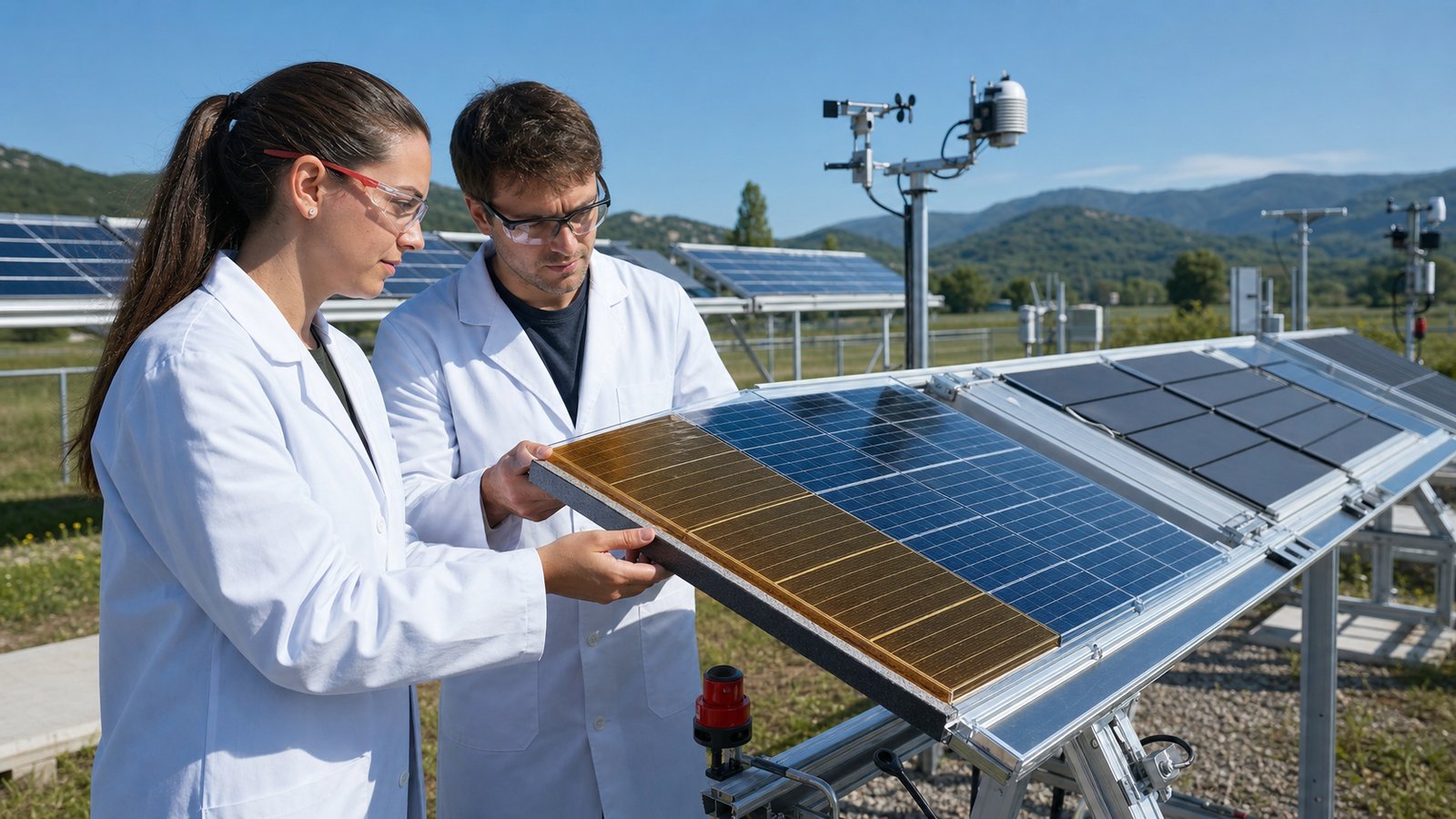
Perovskite-silicon tandem solar cells have already passed an important laboratory milestone: they can convert more sunlight into electricity than a conventional single-junction silicon cell. The next question is harder. Can manufacturers turn that efficiency into large modules that survive heat, moisture, partial shade, voltage stress, transport, and decades outdoors?
That shift from record efficiency to reliability is a sign of progress, not disappointment. Researchers now have enough performance to investigate failure modes that matter in real installations. Recent work on reverse-bias damage shows how a tandem cell can be redesigned for a condition as ordinary as one shaded section of a solar panel. It also illustrates why a promising cell is not yet the same thing as a bankable module.
Two Absorbers Use More of the Solar Spectrum
A silicon solar cell converts only part of the energy in sunlight efficiently. Higher-energy photons lose some energy as heat, while lower-energy photons may pass through without creating useful current. A tandem device stacks absorbers with different bandgaps so each handles a different portion of the spectrum.
In a perovskite-silicon tandem, a tunable perovskite top cell captures higher-energy light and silicon underneath uses more of the lower-energy light. The US Department of Energy’s perovskite research overview notes that this architecture can move beyond the practical ceiling facing a single absorber. Small-area laboratory tandems have reached efficiencies around the mid-30-percent range.
Higher efficiency can produce more power from the same panel area. That matters where roof space, land, wiring, racks, installation labor, or permitting costs dominate. It does not automatically make a module cheaper, but it can spread those balance-of-system costs across more watts.
The Top Cell Adds New Failure Paths
Silicon modules benefit from decades of manufacturing experience and field data. Metal-halide perovskites are younger and chemically more sensitive. Their composition and interfaces can change under light, heat, moisture, oxygen, and electrical stress. Ions can move through the material, contacts can react, and small defects can grow.
The top cell also has to transmit the light intended for silicon. Every transparent contact and transport layer must balance electrical conduction, optical loss, adhesion, and stability. A material that improves a one-centimeter cell may be difficult to coat uniformly over a full module.
A 2025 Nature Photonics review summarized the field around three linked challenges: efficiency, stability, and scalability. Solving one without the others is not enough. A record device made with a slow laboratory process may offer little guidance for a production line, while a durable coating is not useful if it absorbs too much light.
Partial Shade Creates a Serious Electrical Test
When cells are connected in series inside a module, current has to pass through all of them. If one cell is shaded while its neighbors remain illuminated, the shaded cell can be driven into reverse bias. Instead of producing power, it is forced to dissipate energy. That can create hot spots and damage vulnerable layers.
A 2026 Nature Energy study investigated this problem in monolithic perovskite-silicon tandems. The researchers linked abrupt breakdown to an electric-field discontinuity at an interface and introduced graded dielectric layers to smooth that field. In their tests, tandem devices retained more than 92 percent of initial efficiency after 1,000 hours at a reverse bias of minus 15 volts. A large-area multicell string reached 31 percent efficiency and retained more than 90 percent after 1,000 hours of shading stress.
Those are research results under defined test conditions, not a 25-year field warranty. They are valuable because they connect a measurable failure mechanism to a design change and test it at cell and string levels. That is the kind of evidence required to move from impressive output toward predictable behavior.
Scaling Changes the Manufacturing Problem
The best small cells can be made with precise deposition, carefully selected areas, and extensive process control. A factory must coat large surfaces quickly, with high yield and minimal variation. Pinholes, thickness changes, dust, imperfect edges, and nonuniform composition can all reduce module performance.
Manufacturers must also connect cells without losing too much active area, encapsulate moisture-sensitive layers, and design around thermal expansion. The DOE identifies sheet-to-sheet and roll-to-roll coating as possible production approaches, but each requires stable materials and repeatable films. A process that works on polished laboratory silicon may need substantial changes for the textured wafers used by industry.
This is similar to the challenge facing enhanced geothermal systems: the underlying physics can be convincing before the complete engineered system proves reliable and economical at scale.
Efficiency Has Value, but Yield and Lifetime Set the Economics
A National Renewable Energy Laboratory techno-economic analysis found that module efficiency and manufacturing scale can both lower cost per watt. That framing matters. A highly efficient module made with low factory yield, expensive materials, or frequent replacement may not beat mature silicon.
Developers therefore need evidence for energy yield over different climates, degradation rates, repair and replacement assumptions, and end-of-life handling. Lead is used in many high-performing perovskite compositions, so robust encapsulation and credible recycling or recovery plans matter alongside electrical performance. Buyers and project financiers will also expect standardized qualification tests and long-term outdoor data.
Tandems Still Depend on the Rest of the Grid
More efficient panels do not remove the need for transmission, storage, inverters, and flexible demand. Solar output still varies with weather and time of day. Technologies such as grid-forming inverters and long-duration energy storage address different parts of that system.
The value of tandem modules will therefore depend on where they are deployed. Space-constrained roofs and high-cost installations may reward efficiency sooner than utility projects with abundant land. Harsh climates may demand a longer reliability record. There will not be one adoption timetable for every market.
What to Watch Next
Watch for certified large-area module efficiency rather than isolated cell records, multi-year outdoor testing across climates, high-yield manufacturing lines, and warranties backed by operating data. Reverse-bias resilience, damp heat, thermal cycling, ultraviolet exposure, and mechanical loading should be evaluated together rather than as separate laboratory victories.
Perovskite-silicon tandems have earned attention because their efficiency advantage is real. Their next breakthrough will look less dramatic: repeatable modules, transparent test results, predictable degradation, and factories that can make the same good product thousands of times.
Leave a Reply