
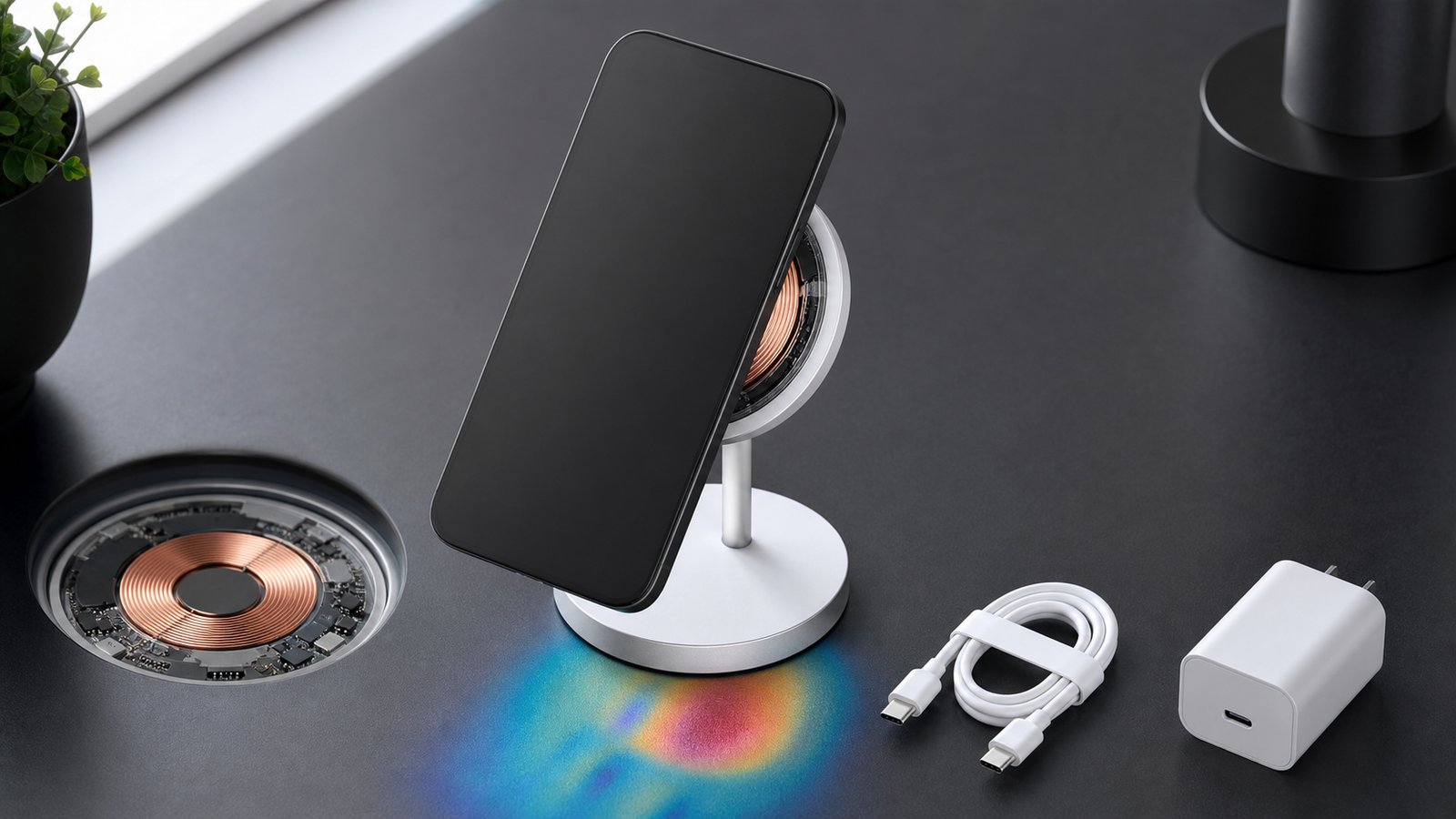
Wireless charging has always traded a little efficiency and speed for convenience. Qi2 improves that trade by using magnets to align a phone and charging coil, reducing the guesswork of placing a device on a pad. The newer Qi2 25W brand raises the available power above the original 15-watt Qi2 level.
For buyers, however, the number on the box is only part of the story. The phone, charger, power adapter, cable, case, temperature, and battery state all affect the rate that reaches the battery. Certification is what separates an interoperable Qi2 product from an accessory that merely uses similar magnets or vague compatibility language.
Alignment Is the Main Upgrade
Inductive charging transfers energy between a coil in the charger and another coil in the phone. The coupling becomes worse when those coils are offset. Energy is then lost as heat, charging can slow, and the device may repeatedly connect and disconnect.
Qi2 introduced the Magnetic Power Profile, which uses a defined magnetic attachment system to place the coils in a consistent position. The Wireless Power Consortium’s Qi overview describes this alignment as a way to improve efficiency, speed, and usability. The practical gain is simple: the phone is less likely to sit slightly outside the charger’s effective area.
Magnets do not eliminate every loss. Wireless transfer still creates more heat than a direct wired connection in many conditions. Alignment instead makes the wireless system more predictable, which is a meaningful improvement for bedside stands, vehicle mounts, and power banks.
Qi2 25W Is a Standardized Power Step
The original Qi2 profile supported 15-watt charging. According to the consortium’s specification history, Qi version 2.2 added support for power transfer up to 25 watts, power modes matched to USB-C adapters, improved power-loss accounting, and checks intended to detect foreign objects before higher-power transfer begins. The consumer-facing Qi2 25W brand is associated with the current 2.2 generation.
Moving from 15 to 25 watts is nearly 70 percent more available power, not a promise that every battery will charge 70 percent faster. Phones reduce power as a battery fills, when temperature rises, or when battery-health controls intervene. A device must also support the higher profile. A 25-watt charger cannot force an older 15-watt receiver to accept more power.
The wall adapter matters too. If it cannot provide the voltage and current requested by the charging system, the pad has no extra energy to deliver. This mirrors the lesson from USB-C common-charger rules: a shared connector or standard does not make every power supply identical.
Certification Is More Important Than Magnetic Appearance
A circular magnet arrangement can make an accessory attach neatly without proving that its charging electronics passed Qi2 tests. The WPC says certified products undergo independent laboratory testing for safety, interoperability, and energy efficiency. Its certification guidance warns that phrases such as “Qi compatible” or “works with Qi” are not the same as Qi Certified.
Consumers can search the consortium’s product database for a Qi ID. That check is especially useful for unfamiliar brands and marketplace listings that reuse certification language loosely. It also helps identify the exact version and power profile rather than assuming every product labeled Qi has magnetic alignment or 25-watt support.
Certification does not rank build quality, hinge durability, cable design, noise, or long-term reliability. It establishes a common technical baseline. Product reviews still need to examine the complete accessory without claiming that one certification answers every buying question.
Qi2 Ready Is a Combination, Not a Hidden Synonym
The consortium also defines Qi2 Ready products. Its logo guidelines explain that a receiver may depend on an approved companion accessory, such as a specific magnetic case, to form a compliant Qi2 combination. Packaging is supposed to identify that dependency.
That distinction matters when a phone does not contain the complete magnetic arrangement by itself. A matching case can supply the mechanical alignment, but buyers should verify that the phone-and-accessory combination is approved rather than assuming any magnetic ring case produces the certified result.
Cases, Stands, and Heat Still Shape Real Performance
A thick or poorly positioned case increases the distance between coils and can interfere with alignment. Metal plates designed for unrelated car mounts may trigger foreign-object protection or create unwanted heating. Camera bumps can also prevent a phone from sitting flat on some pads, which is one reason newer specification revisions include mechanical considerations around nearby obstructions.
Stand geometry matters for comfort and cooling. A charger that holds a phone upright may be useful for video calls or notifications but could run warmer if airflow is restricted. A power bank adds its own conversion losses and battery heat. None of these factors can be inferred from the maximum wattage alone.
Battery temperature is particularly important because the phone controls the final charging rate. A well-designed system will slow down instead of maintaining a headline number under unsafe conditions. That behavior may look disappointing in a short speed comparison, but thermal control is part of responsible charging.
A Practical Buyer Checklist
- Confirm that both the phone and charger support Qi2 25W if higher power is the goal.
- Look for the appropriate certification mark and verify the model in the WPC database.
- Check whether the phone is Qi2 Ready and requires a specific approved case or accessory.
- Use a power adapter and cable that meet the charger’s stated input requirements.
- Compare heat, stability, stand design, cable length, and warranty as well as peak wattage.
This is specification-based guidance, not a hands-on test of a particular product. A real review should measure power over time, temperature, case compatibility, alignment, and behavior with several certified devices. The same evidence-first approach helps when assessing Auracast audio products or interpreting smartphone repairability labels.
What to Watch Next
Watch the certified-product database, not only launch announcements. A healthy ecosystem needs phones, stands, car mounts, power banks, and adapters that work together across manufacturers. More Android receivers with built-in magnetic alignment would make the standard less dependent on particular cases.
Also watch sustained charging curves rather than zero-to-50-percent marketing tests. Qi2 25W makes magnetic wireless charging more capable, but the best accessory will be the one that delivers stable, safe power in the buyer’s actual setup.
Leave a Reply