Frontier Technology Portal Independent technology analysis / Updated daily
Frontier Technology Portal logo
FRONTIER Technology Portal for the next wave of invention

Category: Quantum Computing

Quantum hardware, error correction, algorithms, sensing, and practical timelines.

  • Quantum Hardware Is Entering Its Manufacturing Engineering Phase

    Quantum Hardware Is Entering Its Manufacturing Engineering Phase

    A quantum processor can produce an impressive laboratory result and still be difficult to build twice. The physical device may depend on custom fabrication, hand-selected components, delicate packaging, specialized lasers, ultra-low-temperature equipment, and calibration performed by the people who designed it. That is enough for research. It is not yet a manufacturing system.

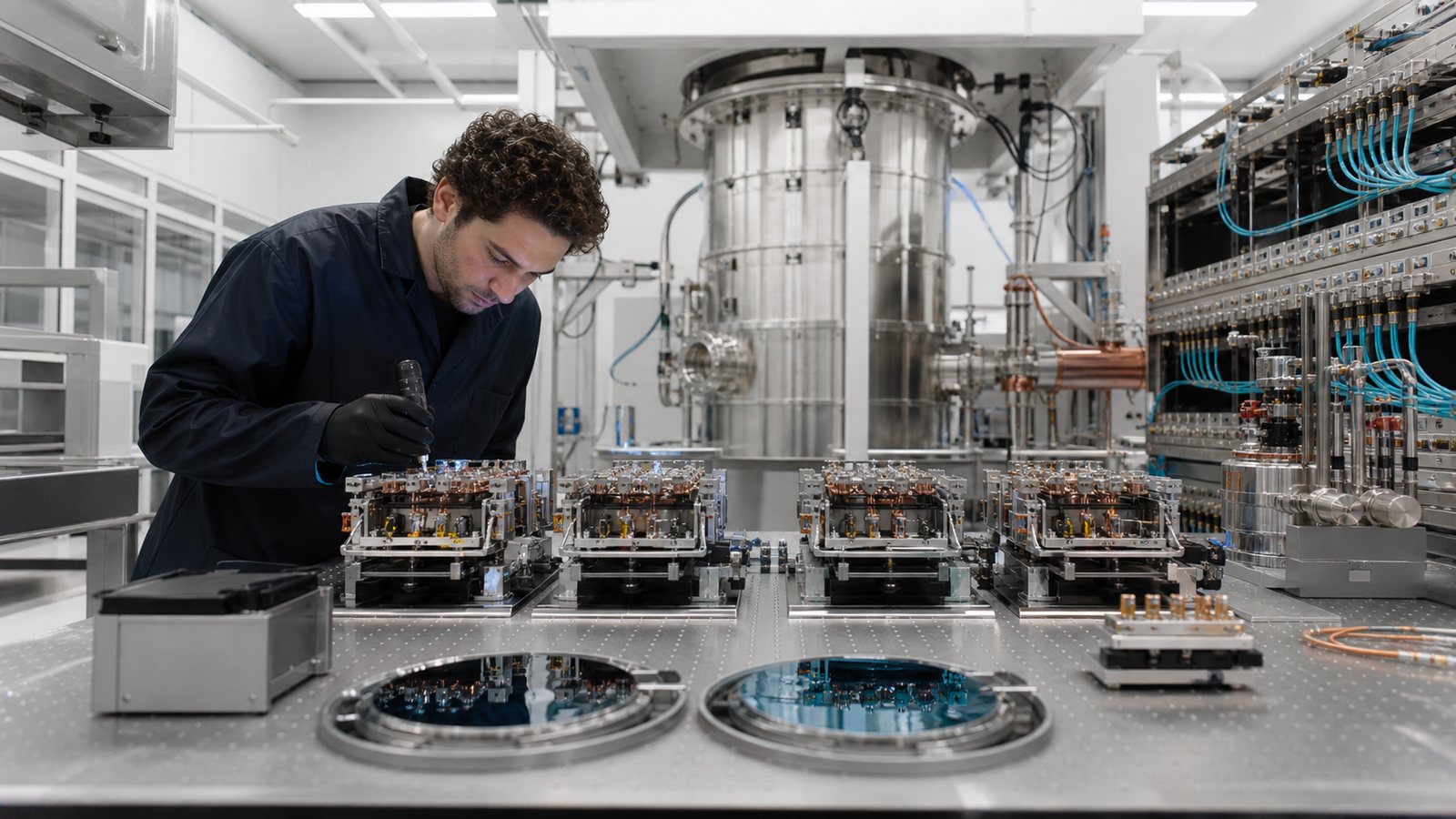
    The next phase of quantum technology is therefore as much about manufacturing engineering as quantum physics. In June 2026, the US National Institute of Standards and Technology announced a Quantum Manufacturing Engineering Center intended to address barriers to scalable components and systems. The shift matters because useful quantum computers, sensors, and communications equipment need repeatable production, measurable quality, repairable supply chains, and specifications that customers can compare.

    A Working Prototype Is Not a Production Process

    Research teams optimize for discovery. They may change a material stack, optical path, control circuit, or cryogenic assembly whenever an experiment suggests an improvement. Manufacturing optimizes a different set of outcomes: yield, repeatability, traceability, throughput, cost, serviceability, and predictable performance across units.

    That transition is hard because quantum systems amplify small variations. Surface contamination, film thickness, alignment, vibration, magnetic fields, temperature gradients, connector loss, or laser noise can alter device performance. A process that succeeds in the hands of one laboratory may drift when transferred to another facility or scaled to a larger batch.

    This is not an argument that one qubit technology must win. Superconducting circuits, trapped ions, neutral atoms, photons, spins, and quantum sensors have different production chains. The manufacturing task is to identify the sensitive variables for each platform and control them well enough to deliver a specified result.

    The Enabling Hardware Is Part of the Product

    The quantum device often receives the headline, but supporting equipment can dominate size, power, integration effort, and reliability. The NIST Quantum Manufacturing Engineering Center announcement specifically points to enabling technologies such as cryostats and lasers, alongside scalable quantum components and systems.

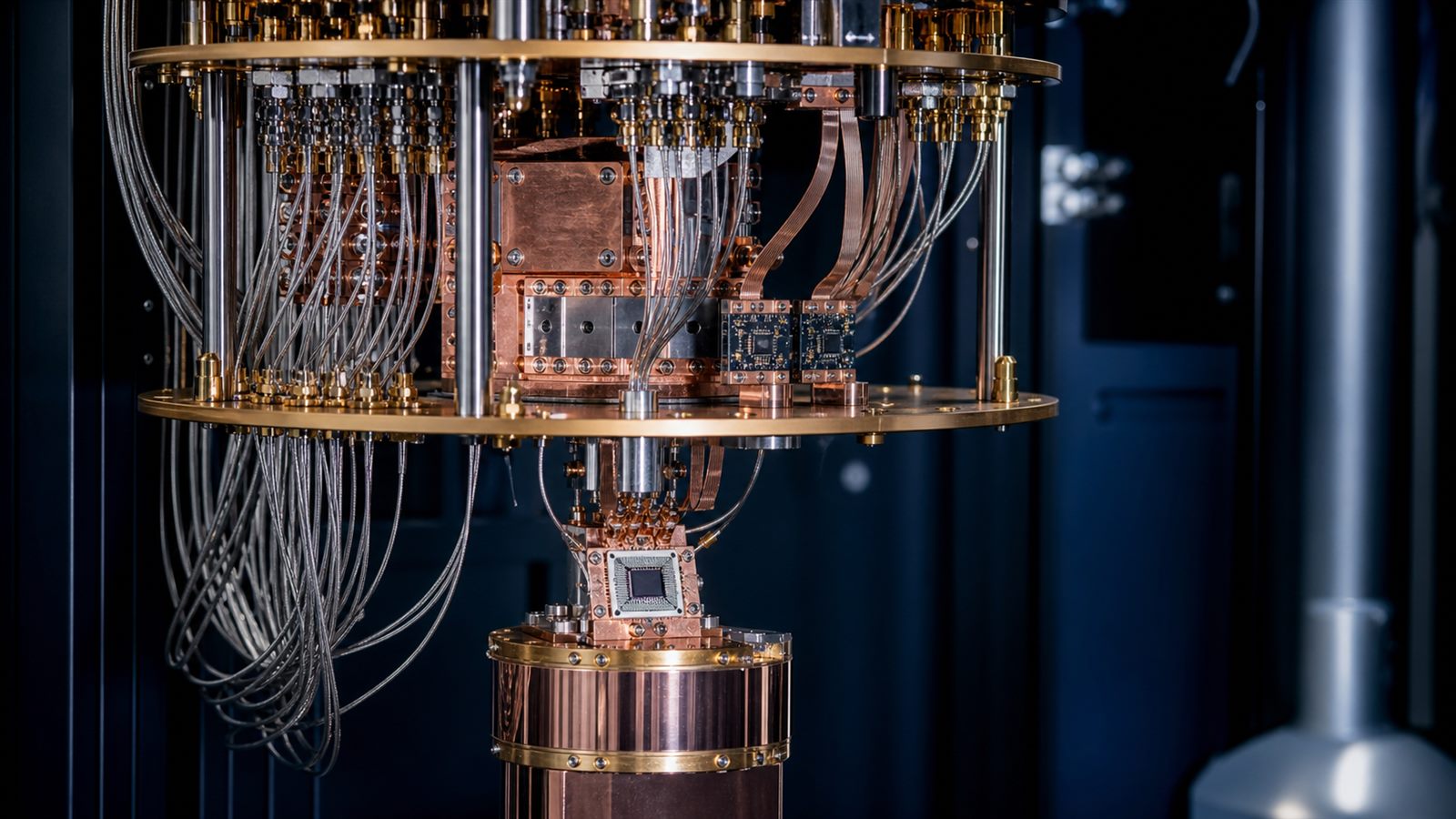
    For superconducting hardware, refrigerators must reach and hold extremely low temperatures while carrying power, control, and measurement signals. Our article on the classical wiring problem in quantum computers explains why adding channels can introduce heat and packaging pressure. Manufacturing engineering must turn that collection of custom parts into qualified modules with known thermal, electrical, and mechanical behavior.

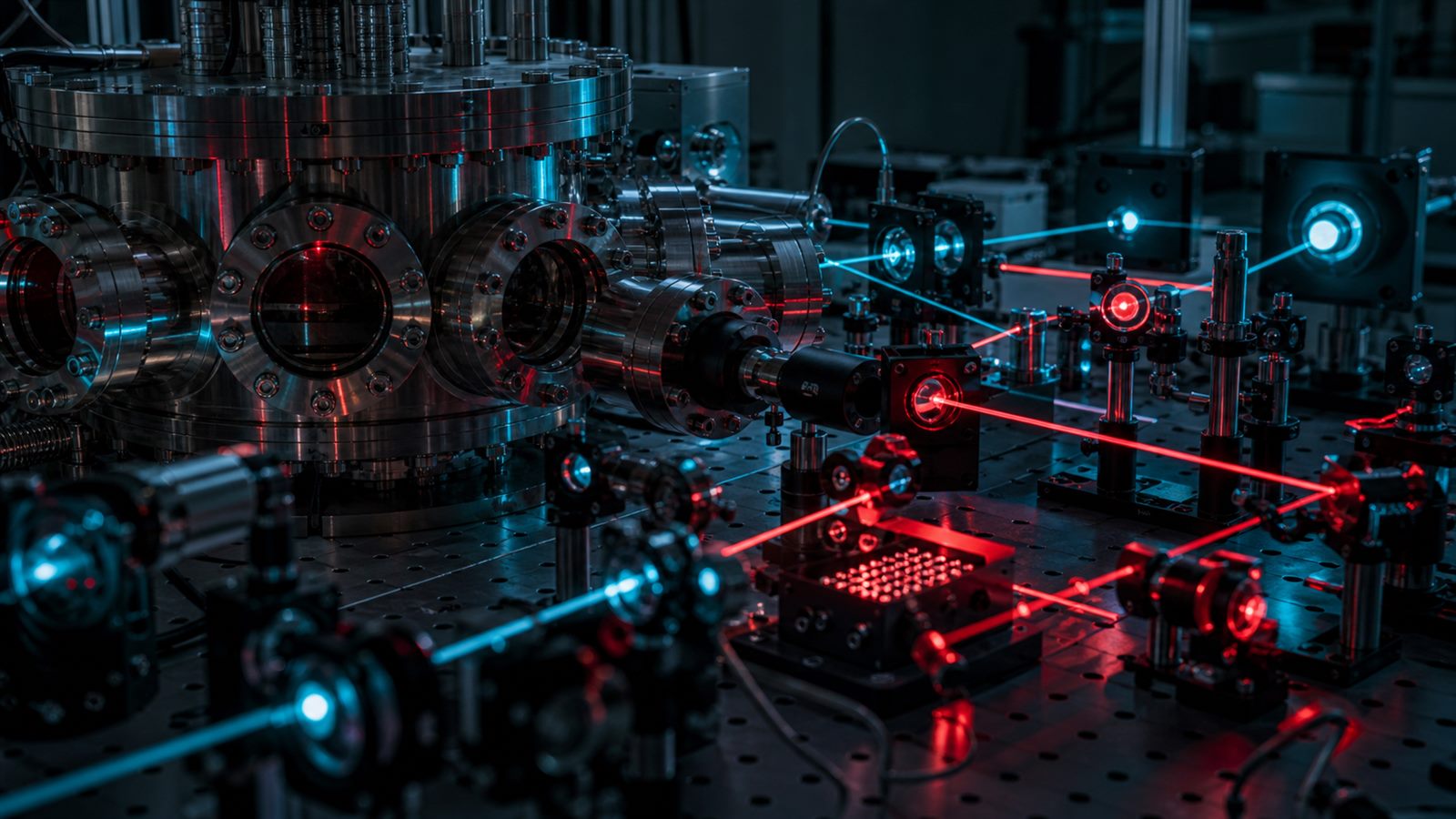
    Optical platforms need stable sources, detectors, modulators, fibers, coatings, and alignment. Neutral-atom systems need precise lasers, vacuum equipment, optics, and control electronics, even though the qubits themselves are atoms. The optical-tweezer approach illustrates why system scalability cannot be judged by atom count alone.

    Yield Is More Informative Than One Exceptional Device

    Semiconductor manufacturing tracks how many devices on a wafer or in a batch meet specifications. Quantum hardware needs similarly useful yield definitions, but the relevant specification may include coherence, gate fidelity, optical loss, frequency placement, detector efficiency, or sensor stability. A device can look structurally correct and still miss the performance window.

    Improving yield starts with finding where variation enters. That can require in-line measurements during fabrication, test structures, process-control samples, automated calibration, and failure analysis that connects final performance back to material and process history. It also requires deciding when a lower-performing component is unusable and when it can be assigned to a less demanding role.

    Reporting only the best unit hides this learning. A production-oriented report should describe distributions, acceptance limits, retest rules, and whether a process remains stable over time. These details are less dramatic than a record result, but they determine whether customers can receive equivalent hardware.

    Metrology Creates a Shared Measurement Language

    Metrology is the science of measurement, including calibration, traceability, and uncertainty. Quantum teams need it to compare results produced by different equipment and laboratories. Without agreed definitions and uncertainty reporting, two vendors can use the same performance term while measuring it in incompatible ways.

    NIST’s May 2026 pre-standardization workshop on quantum metrology gathered industry and measurement institutes to identify urgent characterization needs. That sequencing is sensible: measurement methods need evidence and interlaboratory testing before they harden into standards.

    Metrology also supports supply chains. A buyer of a laser, detector, cryogenic amplifier, or packaged quantum chip needs an acceptance test that both sides understand. Traceable calibration makes it easier to identify whether a problem originated in the component, integration, environment, or control software.

    Standards Should Enable Comparison Without Freezing Design

    Premature standards can lock in the wrong architecture. No standards at all can produce incompatible vocabulary, interfaces, and test claims. The task is to standardize mature horizontal needs while allowing core designs to evolve.

    IEC/ISO Joint Technical Committee 3, created in 2024, covers quantum computing and simulation, metrology, sources, detectors, communications, and enabling technology. Its program includes multiple standards under development. Early work on terminology, measurement, interfaces, and reporting can reduce friction without dictating one qubit type.

    Independent performance evaluation remains necessary. A standardized component test does not prove that an entire computer solves useful problems. That is why manufacturing evidence should sit beside the independent system benchmarks needed to evaluate computational progress.

    Supply Chains Are Wide and Specialized

    Quantum supply chains extend from raw materials and semiconductor tools to vacuum hardware, photonics, microwave electronics, cryogenics, packaging, software, and skilled technicians. Some components are produced by a small number of specialized suppliers. Long lead times or a design change in one layer can delay a complete system.

    A Quantum Economic Development Consortium report identified potential disruptions across raw materials, manufacturing and assembly equipment, and technical talent. The report dates from 2022, but its central engineering point remains relevant: a fast-changing sector cannot assume that a mature, interchangeable supply base already exists.

    Manufacturers can reduce risk through second sources, documented interfaces, component qualification, lifecycle planning, and designs that tolerate reasonable variation. Full vertical integration can solve some early problems, but it may also make systems expensive to reproduce and hard for customers to maintain.

    What Buyers Should Ask

    • How many devices or systems have been produced with the current process?
    • Which performance specifications are acceptance criteria rather than best-case records?
    • How are measurements calibrated, and what uncertainty is reported?
    • Which components have qualified alternatives and which are single-source?
    • What can be replaced, recalibrated, or upgraded without rebuilding the entire system?

    Answers will differ between a cloud-access quantum computer and a sensor purchased as hardware. The purpose is not to demand semiconductor-scale volume from an early industry. It is to distinguish repeatable engineering progress from a single carefully tuned demonstration.

    What to Watch Next

    Watch for the new center’s specific testbeds, reference methods, industry projects, and published manufacturing metrics. Also watch quantum pilot lines in Europe, interlaboratory comparisons, modular cryogenic and photonic components, and standards that define measurement without favoring one architecture.

    Quantum technology will continue to depend on frontier physics. Its commercial credibility, however, will increasingly be measured by ordinary industrial questions: Can the product be built consistently, tested independently, repaired, and delivered again? Manufacturing engineering is where those answers become evidence.
    Sources and Further Reading

  • Quantum Computers Have a Classical Wiring Problem

    Quantum Computers Have a Classical Wiring Problem

    Quantum computers are usually discussed in terms of qubits, errors, and algorithms. A less glamorous component may become just as important: the classical electronics that send instructions to each qubit and read the result. Today’s superconducting systems connect ultra-cold processors to racks of room-temperature equipment through a dense collection of cables.

    That arrangement works for research machines, but it becomes difficult to extend to the very large processors envisioned for fault-tolerant computing. Every line occupies space, carries heat toward the coldest stage, and adds components that must be calibrated. Researchers are therefore moving parts of the control system into the refrigerator, where they can sit closer to the qubits and share lines through multiplexing.

    Quantum Hardware Still Needs Classical Instructions

    A superconducting qubit is manipulated with carefully shaped microwave pulses. Other signals tune components, trigger measurements, amplify faint responses, and move data back to conventional computers. Quantum error correction would require many of these operations to happen repeatedly and with low latency.

    The US National Institute of Standards and Technology describes this scaling challenge as a control and readout bottleneck. Its Flux Quantum Electronics project studies superconducting microwave and mixed-signal circuits that could operate near cryogenic qubits. The aim is to avoid a growing “rat’s nest” of wires between room-temperature racks and a processor inside a cryostat.

    This problem is connected to, but distinct from, qubit quality. A processor can have excellent individual qubits and still be hard to scale if the surrounding control stack consumes too much power, creates noise, or requires one dedicated cable for every operation.

    Putting Control Electronics in the Cold Changes the Architecture

    Conventional electronics are most comfortable near room temperature. A dilution refrigerator, by contrast, has several temperature stages, with the quantum processor operating near absolute zero. Moving control closer to the processor requires circuits that work reliably in the cold while dissipating very little heat.

    Two broad approaches are under active development. Cryogenic CMOS adapts the semiconductor technology used in ordinary computing, often placing controllers at a somewhat warmer stage of the refrigerator. Superconducting digital logic uses Josephson junctions and can operate at much lower temperatures. The technologies differ in power, speed, manufacturing, signal generation, and how closely they can be integrated with qubits.

    The architectural benefit is multiplexing. One incoming control path can be distributed among several qubits by local electronics, reducing the number of cables that must cross temperature boundaries. The cost is that active circuits now sit near extremely sensitive quantum hardware.

    A 2026 Experiment Integrated Digital Control With Qubits

    A 2026 study in Nature Electronics reported an active quantum processor unit that combined superconducting qubits and single-flux-quantum digital control electronics in one multi-chip module. The chips were connected with flip-chip bonding, a packaging method that creates short, dense electrical connections between facing dies.

    The system used digital demultiplexing to route control pulses to several qubits instead of preserving a simple one-line-per-qubit relationship. The researchers reported single-qubit gate fidelities above 99 percent and as high as 99.9 percent in their experiments.

    Those results show that nearby superconducting control can operate without automatically destroying useful qubit performance. They do not demonstrate a large fault-tolerant computer. The experiment involved a limited module, and scaling it would require more routing, more simultaneous activity, more readout, and tighter management of heat and interference.

    Heat and Noise Are the Central Trade-Off

    The coldest stage of a dilution refrigerator has very little cooling capacity. A control circuit that seems low-power by ordinary chip standards may still release too much heat close to the qubits. Cables create passive heat paths, while active circuits generate heat whenever they switch. Engineers must decide which functions belong at room temperature, which can move to a warmer cryogenic stage, and which need to sit at millikelvin temperatures.

    Electrical noise is equally important. Qubits can lose coherence when they interact with unwanted electromagnetic signals or nonequilibrium particles. Local control can shorten connections and reduce cable count, but it also places switching electronics near the device being protected. Packaging, shielding, filtering, timing, and thermal design become one combined problem.

    This is why system-level evidence matters alongside a headline fidelity number. Useful tests must include many simultaneous operations, idle qubits, repeated error-correction cycles, and the thermal behavior of a complete control stack.

    Wireless and Optical Links Offer Other Ways Through the Refrigerator

    Researchers are also exploring alternatives to conventional copper coaxial cables. A 2025 Nature Electronics study demonstrated a wireless terahertz cryogenic interconnect built with CMOS technology. Its 260-gigahertz architecture was designed to move information between temperature stages while reducing the ratio of heat delivered to information transferred.

    Optical links pursue a related goal. Fibers conduct less heat than metal cables and can carry high data rates, but converting between light and the microwave signals used by superconducting qubits introduces efficiency, noise, and packaging challenges. The most realistic future system may mix technologies: optical or wireless links between stages, cryogenic electronics for local routing, and short microwave connections at the processor.

    That hybrid direction also connects with work on photonic quantum hardware, although the roles are different. In a superconducting machine, light may serve as part of the classical control or readout infrastructure rather than as the qubit itself.

    Control Scaling Cannot Be Judged by Qubit Count

    A vendor can increase the number of qubits in a processor while leaving major questions about control unresolved. Readers should look for the number of independent control and readout channels, the degree of multiplexing, power at each temperature stage, simultaneous gate performance, calibration overhead, and the effect of control activity on neighboring qubits.

    Independent measurement is especially important because architectures make different trade-offs. A system optimized for a short demonstration may not sustain deep circuits or continuous error correction. This is another reason quantum computing needs independent benchmarks rather than a race based on one hardware number.

    The surrounding software matters too. Multiplexed hardware needs schedulers that avoid conflicting pulses, calibration tools that track drift, and diagnostics that locate failures across quantum and classical components. As processors grow, control electronics will look less like laboratory instruments and more like a specialized data-center network operating across extreme temperatures.

    What to Watch Next

    The next milestones should demonstrate cryogenic control across larger qubit arrays while preserving coherence during simultaneous operation. Watch for measured power per controlled qubit, control-line reduction, readout integration, packaging yield, and operation over long error-correction experiments.

    Also watch how teams divide functions across temperature stages. A successful design may not put everything beside the qubits. It will place each task where latency, power, noise, and repairability make sense. Comparisons with neutral-atom quantum computers are useful because other qubit platforms face different control bottlenecks.

    Useful quantum computing will require better qubits and better error correction. It will also require an enormous classical machine capable of controlling those qubits without overwhelming their environment. The wiring problem is not a side issue. It is part of the computer.

    Sources and Further Reading

  • Photonic Quantum Computers Use Light, Measurement, and Manufacturing

    Photonic Quantum Computers Use Light, Measurement, and Manufacturing

    Quantum computers are often pictured as chandeliers of cold metal surrounding superconducting chips. Photonic quantum computing starts from a different carrier: individual particles of light. A photon can encode quantum information in its path, polarization, arrival time, wavelength, or other optical properties, then travel through waveguides and interfere with other photons.

    Light is naturally useful for moving information and can interact weakly with the environment, but those advantages create a demanding engineering problem. Useful machines need reliable photon sources, exceptionally low-loss optical circuits, fast switching, precise detectors, classical control, and error correction. The real story is therefore not that photons make quantum computing easy. It is that advances in semiconductor-style manufacturing are turning a collection of optical experiments into a possible technology stack.

    A Photonic Qubit Is Information Carried by Light

    A conventional bit is either zero or one. A qubit can occupy a controlled superposition of two states until it is measured. In a dual-rail photonic design, for example, one photon distributed across two optical paths represents the logical alternatives. Beamsplitters and phase shifters manipulate the relative probability amplitudes.

    When photons are made indistinguishable and brought together in a carefully designed circuit, quantum interference creates correlations that have no classical equivalent. Detectors then convert selected optical outcomes into classical signals. NIST’s quantum-computing overview lists photonic qubits alongside trapped ions, neutral atoms, superconducting circuits, and other approaches, each with different control and scaling trade-offs.

    Measurement Can Be Part of the Computation

    Photonic architectures do not all imitate a circuit built from deterministic two-qubit gates. In measurement-based and fusion-based approaches, a system first creates small entangled resource states. Special joint measurements, often called fusion measurements, connect those resources into a larger entangled structure. The choice and result of later measurements drive the computation.

    Because an optical measurement can consume the photons being measured, the system must continually create and route fresh resources. Detector results also need to reach fast classical electronics so the machine can choose subsequent operations or interpret the output correctly. Computation is a coordinated pipeline of optics, cryogenic detection in some designs, electronics, networking, and software.

    Manufacturing Is Central to the Scaling Argument

    A 2025 Nature paper from the PsiQuantum team described photonic modules fabricated with a commercial 300-millimeter silicon-photonics process. The work demonstrated components for photon generation, manipulation, detection, two-photon interference, fusion, and chip-to-chip interconnection at telecommunications wavelengths.

    The important point is not a claim that the paper demonstrated a useful universal computer. It did not. The paper presented a component platform and reported performance for key building blocks, with several results conditional on photon detection. The scaling argument is that established semiconductor manufacturing can produce large numbers of similar optical devices and connect them with mature fiber technology.

    Manufacturability includes yield, repeatability, packaging, thermal control, fiber attachment, and testing. A laboratory can tune one optical path by hand; a large machine needs millions of operations to behave predictably with automated calibration.

    Photon Loss Is a Formidable Error Channel

    A photon may be lost in its source, a waveguide, a switch, a connector, or a detector. Once it disappears, no amplifier can copy the unknown quantum state because quantum information cannot be cloned. Loss therefore accumulates across the entire path from generation to measurement.

    Engineers reduce loss with better materials, low-loss waveguides, efficient coupling, and high-efficiency detectors. Error-correcting architectures must also tolerate a finite amount of loss. This links photonic hardware to the broader challenge explained in our guide to quantum error correction: physical component metrics matter only in relation to the logical error rate and resources required by a useful algorithm.

    Photon Sources Are Usually Probabilistic

    Many photonic sources do not emit one perfect photon on command every time. A heralded source uses another detection event to announce that a desired photon was probably created. To make this useful at scale, a machine may operate many sources in parallel, store successful photons briefly, and use fast switches to route them into the correct circuit.

    This multiplexing trades one problem for several others: more components, switch loss, timing complexity, and tighter control requirements. Integrated sources of more complex optical states are another research direction. A 2025 Nature experiment demonstrated an integrated photonic source of Gottesman-Kitaev-Preskill, or GKP, qubit states, an encoding studied for fault-tolerant optical architectures. It was a building-block result, not a finished processor.

    Better Fusion Measurements Can Reduce Overhead

    With basic linear optics, a standard Bell-state measurement cannot always distinguish all possible outcomes, limiting its success probability. A 2025 experiment in npj Quantum Information used an added entangled photon pair and a larger optical network to demonstrate a boosted measurement above the usual 50 percent limit.

    Higher fusion success can improve tolerance to loss and reduce resource overhead, but the extra photons and optical components also have costs. The relevant comparison is end-to-end: how many sources, switches, detectors, and physical photons are needed for one reliable logical operation?

    Detectors Complicate the Room-Temperature Story

    Some optical manipulation can occur without keeping the main processing chip at the extreme temperatures used by superconducting qubits. That is an advantage, but it should not be simplified into a claim that an entire photonic quantum computer runs like an ordinary room-temperature computer.

    High-performance single-photon detectors often use superconducting materials and cryogenic cooling. Sources, control electronics, lasers, and packaging have their own environmental requirements. A system may distribute these components across temperature zones, which reduces some cooling demands while creating integration and latency challenges.

    Networking Is a Natural Strength

    Photons already carry data through telecommunications fiber, so photonic qubits fit naturally with quantum communication and modular machine designs. Chip-to-chip optical links could connect separately manufactured modules rather than requiring every component on one enormous die.

    That does not make long-distance quantum networking automatic. Fiber loss, source quality, memories, synchronization, and repeaters still matter, as our quantum networks explainer describes. The benefit is architectural compatibility, not the removal of network physics.

    How to Evaluate Photonic Progress

    Raw photon count is not a useful equivalent of qubit count. Readers should look for source efficiency, indistinguishability, optical loss, detector efficiency, feed-forward speed, two-photon interference quality, fusion fidelity, and whether reported results are conditional on successful detection. Logical error rates and resource estimates are more informative than a component record in isolation.

    Comparisons with neutral-atom systems or superconducting machines also need a defined workload and error-correction assumption. Each platform counts and connects physical resources differently.

    Limits and What to Watch Next

    No current photonic platform has demonstrated a large, general-purpose, fault-tolerant computer running commercially useful algorithms. The path still includes reducing total loss, producing states reliably, integrating fast switches and detectors, validating error-corrected operations, and manufacturing complete modules at high yield.

    Watch for demonstrations that integrate many previously separate functions, report unconditional end-to-end performance, and operate logical qubits for increasingly complex circuits. The most meaningful milestone will not be another beautiful optical component. It will be evidence that a manufactured system can turn millions of components into fewer, dependable logical resources.

    Sources and Further Reading

  • Neutral-Atom Quantum Computers Use Optical Tweezers to Move Qubits

    Neutral-Atom Quantum Computers Use Optical Tweezers to Move Qubits

    A neutral-atom quantum computer begins with something surprisingly tangible: individual atoms held in place by tightly focused beams of light. These optical tweezers can arrange atoms into programmable patterns, move them to fill empty sites, and bring selected neighbors into the right geometry for quantum operations. The approach has recently produced experimental systems containing thousands of trapped atoms, giving neutral atoms one of the most visually intuitive paths toward larger quantum processors.

    Scale, however, is only the first requirement. A useful machine must initialize qubits, perform accurate gates, measure results, replace lost atoms, and eventually run error correction without the control system becoming unmanageable. Neutral-atom platforms are interesting because the same physics offers answers to several of those problems, while leaving difficult engineering work between today’s demonstrations and fault-tolerant computing.

    How an Atom Becomes a Qubit

    Neutral-atom machines commonly use stable internal energy states of an atom to represent the logical values zero and one. Lasers prepare, control, and read those states. Because atoms of the same isotope are naturally identical, manufacturers do not have to fabricate thousands of nominally matching qubit devices one by one. The challenge shifts to trapping and controlling those atoms with highly stable optical, vacuum, and electronic systems.

    An optical tweezer forms where a focused laser creates an energy landscape that can confine a cold atom. An array of many focused spots creates many potential qubit locations. Loading is probabilistic, so the first pattern usually contains vacancies. Cameras identify occupied sites, and movable tweezers rearrange the atoms into a denser, ordered register.

    This ability to change geometry is more than a setup convenience. It can place qubits into layouts suited to a particular algorithm, move selected atoms toward interaction zones, or remove atoms used for one role from those used for another. It is a physical version of reconfigurable connectivity.

    Rydberg States Switch Interactions On

    Atoms held apart in the array interact only weakly in their ordinary states. To create an entangling gate, laser pulses can briefly excite selected atoms into high-energy Rydberg states. Rydberg atoms have strong, long-range interactions. If one nearby atom is already excited, that interaction can shift the energy levels and prevent another excitation, an effect called Rydberg blockade.

    Carefully designed pulse sequences use this blockade to make the state of one qubit affect another. After the operation, the atoms return to the computational states. The interaction is therefore controllable: qubits can remain relatively isolated for storage and become strongly coupled for a gate.

    The same mechanism is demanding. Laser frequency, intensity, timing, atom temperature, position, and environmental fields all influence fidelity. A large array is valuable only if these controls remain sufficiently uniform and if gates can be performed in parallel without unacceptable cross-talk.

    Why Moving Qubits Changes the Architecture

    Some quantum processors rely on a fixed map of neighboring connections. Neutral atoms can instead use transport to alter which qubits meet. That flexibility could reduce the number of extra swap operations needed to bring distant logical information together. It also supports architectures with separate storage, processing, and measurement regions.

    Moving an atom is not instantaneous or error-free. The transport must avoid heating the atom, disturbing its quantum state, colliding with another path, or allowing too much decoherence while the computation waits. An architecture therefore has to balance movement against direct gates and schedule many operations efficiently.

    This is one reason independent performance evaluation matters. As our guide to quantum-computing benchmarks explains, qubit count cannot describe gate accuracy, connectivity, speed, measurement quality, or the overhead of running a complete circuit.

    Recent Experiments Show Larger, Refillable Arrays

    A 2025 Nature paper reported a coherent array of more than 6,100 neutral-atom qubits assembled with optical tweezers. The result focused on the technologies needed to load, image, and maintain a very large atomic register. It demonstrated that neutral-atom control can extend well beyond the hundreds of sites common in earlier experiments.

    A separate 2025 Nature study reported continuous operation of a coherent system with more than 3,000 qubits. It used an additional reservoir and repeated reloading to replenish atoms without rebuilding the entire array from the beginning. That capability addresses a distinctive failure mode: atoms can be lost from traps during operation or measurement.

    Neither result means a 3,000- or 6,100-qubit fault-tolerant computer already exists. Preparing a large coherent register and executing deep, high-fidelity logical circuits are different milestones. These experiments are best understood as evidence that loading, rearrangement, and maintenance can scale, not as a direct comparison with a smaller processor running another qubit technology.

    Atom Loss Is Both a Problem and a Detectable Error

    A neutral atom may leave its trap after a collision, an imperfect pulse, or measurement. That removes the physical qubit entirely. Loss is disruptive, but it can sometimes be easier to identify than an unknown change of state because imaging reveals that a site is empty. Quantum error-correction schemes can use that location information if detection and replacement happen reliably.

    Reloading from a reservoir could let a processor replace lost physical qubits during a long computation. The hard part is doing so without damaging nearby data and while preserving the timing and structure of the error-correcting code. Fast, selective measurement and reset are therefore as important as the number of storage sites.

    This connects directly to why quantum error correction matters. A logical qubit is encoded across many physical qubits so that errors can be detected and corrected. If physical operations remain too noisy, adding more atoms can increase the amount of error-management work rather than producing a more useful computer.

    From Physical Arrays to Logical Operations

    Another 2025 Nature experiment demonstrated elements of a fault-tolerant neutral-atom architecture using up to 448 atoms. The work combined optical-tweezer transport, Rydberg gates, mid-circuit operations, and error-correction techniques. It is an important systems result because fault tolerance depends on many components working together, not on a record qubit count in isolation.

    The long-term target is a logical error rate that falls as the code grows, while the machine continues to perform gates and measurements quickly enough to complete useful work. Achieving that requires high-fidelity two-qubit operations, reliable readout, stable qubit memory, low loss, parallel control, and decoders that interpret error data in real time.

    Where Neutral Atoms May Fit

    Programmable atom arrays are already useful as analog quantum simulators, where the natural interactions reproduce a many-body model of interest. Digital quantum computing imposes a different requirement: a universal set of calibrated gates assembled into circuits. A platform may support both modes, but results from one should not automatically be read as performance in the other.

    Neutral atoms also have potential links to quantum networking because atoms can store quantum states and interact with light. Building a practical network requires efficient photon interfaces, memories, repeaters, and low-loss transmission, topics covered in our introduction to quantum networks and entanglement distribution. That opportunity remains separate from proving a scalable local processor.

    Limits Behind the Impressive Images

    The beautiful grid of bright dots in an experimental image can make a neutral-atom computer look finished. In reality, the supporting apparatus includes ultra-high-vacuum hardware, multiple stabilized lasers, imaging systems, optical modulators, magnetic-field control, and substantial classical electronics. Calibration and uptime will matter as much as the atomic physics when these systems move from research laboratories toward dependable computing services.

    Comparisons across platforms also need care. Superconducting circuits, trapped ions, photonics, silicon spins, and neutral atoms have different gate times, connectivity, loss mechanisms, and definitions of a qubit that is available for computation. The relevant question is which system can deliver verified logical performance for a useful workload at an acceptable cost and reliability.

    What to Watch Next

    Watch for repeated logical operations rather than one-time physical-array records. Useful evidence will include two-qubit gate fidelity across a large fraction of the register, parallel operation, loss and reload rates, mid-circuit measurement, logical error suppression, circuit depth, and end-to-end application benchmarks. Researchers also need to show that control complexity and calibration time do not grow faster than the machine’s useful capacity.

    Optical tweezers give neutral-atom computing a compelling physical toolkit: identical qubits, programmable geometry, switchable interactions, and the possibility of replacing lost atoms. The next stage is turning those tools into a processor whose logical reliability, not just its atom count, improves as it grows.

    Sources and Further Reading

  • Quantum Computing Needs Independent Benchmarks More Than Bigger Qubit Counts

    Quantum Computing Needs Independent Benchmarks More Than Bigger Qubit Counts

    Quantum computing announcements often lead with a qubit count. That number is easy to understand and easy to compare, but it says little on its own about whether a machine can complete a valuable calculation. Qubits differ in quality, connectivity, speed, control overhead, and error behavior. A smaller, more reliable system can outperform a larger machine on a particular workload.

    The industry therefore needs independent benchmarking that connects hardware claims to useful, repeatable computation. The US Defense Advanced Research Projects Agency is taking an unusually direct approach through its Quantum Benchmarking Initiative, or QBI: evaluate whether any proposed architecture can plausibly reach utility-scale operation, then verify the engineering plans behind it.

    Why Qubit Count Is an Incomplete Metric

    A physical qubit is a controllable quantum system, but physical qubits are noisy. Their state can be disturbed by imperfect operations, environmental interactions, measurement, and control errors. Useful fault-tolerant computing is expected to encode more reliable logical qubits across many physical qubits while continuously detecting and correcting errors.

    The physical-to-logical overhead depends on hardware error rates, error correlations, the error-correcting code, connectivity, measurement speed, and the target algorithm. Two processors with the same physical-qubit count may therefore support very different logical capabilities. This is why our guide to quantum error correction focuses on controlled operations and logical reliability rather than a single headline number.

    Execution speed matters too. A processor that performs a high-fidelity operation slowly may be better for one task and worse for another. Connectivity determines how much extra work is needed to move quantum information. Calibration time and uptime determine whether a nominally powerful machine is available long enough to finish a useful job.

    What DARPA Means by Utility Scale

    DARPA describes utility-scale quantum computing as operation whose computational value exceeds its cost. QBI aims to rigorously verify whether any participating approach could reach that point by 2033. This definition is deliberately more demanding than demonstrating quantum behavior or running a small benchmark that is difficult to reproduce classically.

    The program uses stages. In Stage A, teams describe a concept for a useful fault-tolerant computer. In Stage B, they develop detailed research and development plans, identify risks, and specify prototypes that can reduce those risks. In the final stage, a government verification and validation team is expected to test whether the concept can be constructed and operated as designed.

    As of November 6, 2025, DARPA said 11 companies had been selected for Stage B, with teams entering the process on different timelines. The agency explicitly says QBI is not a competition intended to select one winner. Multiple approaches, one approach, or none may ultimately demonstrate a credible path.

    Different Architectures Need Comparable Questions

    Superconducting circuits, trapped ions, neutral atoms, photonic systems, spin qubits, and other platforms solve the engineering problem differently. They operate at different temperatures, use different control systems, and face different scaling constraints. A fair benchmark should not assume that one platform’s easiest metric represents every architecture.

    Comparable evaluation can instead ask a shared set of questions. How many logical operations can run before failure? How quickly can the system detect and correct errors? What resources are required for one logical qubit? Can control electronics and cryogenic or optical equipment scale with the processor? How often is the machine available, and how much classical computation is required around it?

    NIST’s quantum program emphasizes measurement science, performance benchmarking, and standards for this reason. Reproducible methods allow laboratories and vendors to compare measurements without pretending the underlying machines are identical.

    A Useful Benchmark Needs a Real Workload

    Component measurements such as gate fidelity and readout error are essential, but they do not automatically predict application performance. Errors can correlate, calibration can drift, and a circuit can amplify small weaknesses. A system-level benchmark should include workloads that exercise the processor in representative ways.

    The workload must also have a clear success criterion. If a classical computer can efficiently verify the answer, the comparison is easier to trust. If verification is itself intractable, evaluators need statistical checks, smaller validated instances, or other evidence that the quantum result is correct.

    Economic value adds another layer. A calculation may be technically impressive but too slow, expensive, energy intensive, or specialized to justify the full system. Utility depends on the cost of hardware, facilities, operators, error correction, classical control, and repeated runs, not only processor time.

    Benchmarks Can Be Gamed

    Every benchmark creates incentives. A vendor may tune hardware and software for one task, exclude setup time, report the best run, or compare against an outdated classical method. Results can also depend heavily on compiler choices and problem structure. Independent evaluators need access to assumptions, run conditions, uncertainty, and enough data to reproduce the conclusion.

    That does not mean benchmark-specific optimization is dishonest; classical computing uses optimized benchmarks too. The problem arises when a narrow demonstration is presented as evidence of general usefulness. Readers should ask what the benchmark measures, what it excludes, and whether another laboratory reproduced it.

    Networking and Sensing Need Different Measures

    Quantum technology is broader than computing. A network is judged by entanglement rate, distance, fidelity, memory time, and interoperability, as explained in our article on quantum networks. A sensor may be judged by sensitivity, stability, bandwidth, and performance outside a laboratory. Those measurements should not be collapsed into a generic claim of quantum advantage.

    This distinction also explains why useful devices can appear on different timelines. Our overview of quantum sensors describes applications that do not require a universal fault-tolerant processor. Independent benchmarking should clarify which technology and task are actually under discussion.

    What Ordinary Readers Should Look For

    When a company announces a quantum milestone, look beyond the number of qubits. Ask whether the result used physical or logical qubits, whether error correction ran during the calculation, how success was verified, and whether independent researchers had access to the system. Check whether the comparison includes current classical hardware and algorithms.

    Also look for engineering evidence: repeatable fabrication, control-system scaling, cooling or laser requirements, calibration burden, and uptime. A credible road map identifies risks and prototypes that can disprove assumptions, not only milestones that confirm them.

    What to Watch Next

    QBI’s most valuable outputs may be the verification methods and risk evidence rather than a simple ranking. Watch which teams progress, what independent measurements become public, and whether evaluators can connect logical performance to costed systems. International standards work at NIST, ISO, and IEC will also matter for consistent terminology and measurement.

    Quantum computing will not become easier to evaluate by adding more headline numbers. It will become easier when claims are tied to reproducible workloads, logical reliability, full-system resources, and independent inspection. That is a slower story than a qubit race, but it is the one that can reveal whether a useful computer is actually being built.

    Sources and Further Reading

  • Quantum Networks Explained: Entanglement, Repeaters, and the Road Ahead

    Quantum Networks Explained: Entanglement, Repeaters, and the Road Ahead

    A quantum network is not simply a faster version of the internet. Its purpose is to connect quantum devices so they can share entanglement, transfer quantum states, and coordinate measurements that classical networks cannot reproduce in the same way. The idea could eventually support distributed quantum computing, highly precise sensing, and new approaches to secure communications. The engineering, however, is still at an early stage.

    That distinction matters because the phrase “quantum internet” can make an experimental field sound like a finished consumer product. In 2026, researchers are building testbeds, interfaces, memories, detectors, and repeater components. These systems are teaching engineers how to move fragile quantum information between different types of hardware. They are not replacing ordinary fiber networks, cloud services, or Wi-Fi.

    What a Quantum Network Actually Carries

    A conventional network moves bits that can be copied, amplified, buffered, and checked repeatedly. A quantum network works with qubits encoded in physical systems such as photons, trapped ions, atoms, or superconducting circuits. A qubit can exist in a combination of states, but measuring it generally changes the information it carries. Unknown quantum states also cannot be copied perfectly.

    Those rules make networking difficult, but they create useful possibilities. Two distant quantum systems can share entanglement, a correlation that has no direct classical equivalent. Entanglement does not allow messages to travel faster than light. Classical communication is still required to interpret measurement results and coordinate operations. What it can provide is a shared quantum resource for tasks such as linking processors or comparing measurements across separated sensors.

    This makes quantum networking a companion to the work described in our guide to quantum error correction. A useful network must preserve quantum information long enough for operations to succeed, just as a useful quantum computer must control errors inside a processor.

    Why Ordinary Repeaters Do Not Work

    Light is lost as it travels through optical fiber. Classical networks solve this problem with repeaters that read a weak signal, regenerate it, and send a clean copy onward. A quantum repeater cannot simply inspect and copy an unknown qubit. Instead, it must create entanglement across shorter links, store quantum states temporarily, perform carefully timed operations, and use entanglement swapping to extend the connection.

    Every part of that sequence is demanding. Photon sources must be stable. Detectors need high efficiency and low noise. Quantum memories must hold information without destroying its coherence. Separate nodes need precise timing. Components that work at different wavelengths or physical temperatures must exchange information without losing the quantum state.

    The last challenge is called transduction. Many superconducting quantum processors operate with microwave signals inside extremely cold refrigerators, while optical photons are better suited to traveling through long-distance fiber. Converting information between those domains with high fidelity is one of the central hardware problems in the field.

    What Researchers Are Building in 2026

    The US National Institute of Standards and Technology is developing quantum network testbeds to study devices, control layers, time synchronization, classical and quantum traffic sharing, and possible vulnerabilities. Its work includes photon sources, detectors, memories, transducers, and repeater technologies rather than one monolithic “internet” machine.

    One NIST group is designing an optical channel intended to create remote microwave entanglement for superconducting quantum computers. The project aims to connect stationary microwave-domain hardware to mobile optical information and is expected to become operational by the end of 2026. Another NIST effort uses trapped ions as stationary qubits and telecom-wavelength photons as carriers for longer links.

    These projects reveal the practical shape of early quantum networks: small numbers of specialized nodes, expensive laboratory hardware, tightly controlled links, and extensive classical coordination. Progress should be judged by connection fidelity, entanglement rate, useful distance, uptime, and compatibility between devices, not by a single headline number.

    The First Useful Applications May Be Specialized

    Distributed quantum computing is one long-term goal. Instead of building one enormous processor, engineers might link smaller processors and use entanglement to coordinate certain operations. That approach could make modular systems possible, but only if network errors and delays remain below demanding thresholds.

    Networked sensing may mature on a different timeline. Shared quantum resources could improve certain measurements of time, fields, motion, or distant signals. This overlaps with the near-term possibilities discussed in our article on quantum sensors.

    Quantum key distribution is another frequently discussed application, but it should not be confused with the whole field. It requires specialized physical links and does not replace the need to secure endpoints, software, identities, and network operations. For most organizations, the immediate cryptography task is the software-based transition described in our post-quantum cryptography guide.

    What Quantum Networks Will Not Replace

    A quantum network will still depend on classical networks. Control messages, scheduling, error reports, software updates, authentication, and most user data remain classical. Quantum channels are likely to be added where a specific quantum resource is valuable, much as accelerators are added to computers for specialized workloads.

    Nor does entanglement eliminate latency. Coordinating distant nodes still requires ordinary signals that obey the speed of light. A quantum link is therefore not a shortcut for instant communication, faster video streaming, or lower gaming latency.

    What to Watch Next

    The most useful milestones will be repeatable demonstrations outside a single custom experiment. Watch for longer-lived quantum memories, higher-rate entanglement distribution, microwave-to-optical transducers with lower loss, interoperable control protocols, and testbeds that connect hardware from more than one vendor or laboratory.

    Quantum networking is best understood as infrastructure research. The field is assembling the physical and software layers required to connect quantum systems reliably. If those layers mature, the result will not replace today’s internet. It will add a new kind of network resource for problems that genuinely benefit from quantum information.

    Sources and Further Reading

  • Quantum Sensors May Arrive Before Quantum Computers

    Quantum Sensors May Arrive Before Quantum Computers

    Updated July 16, 2026.

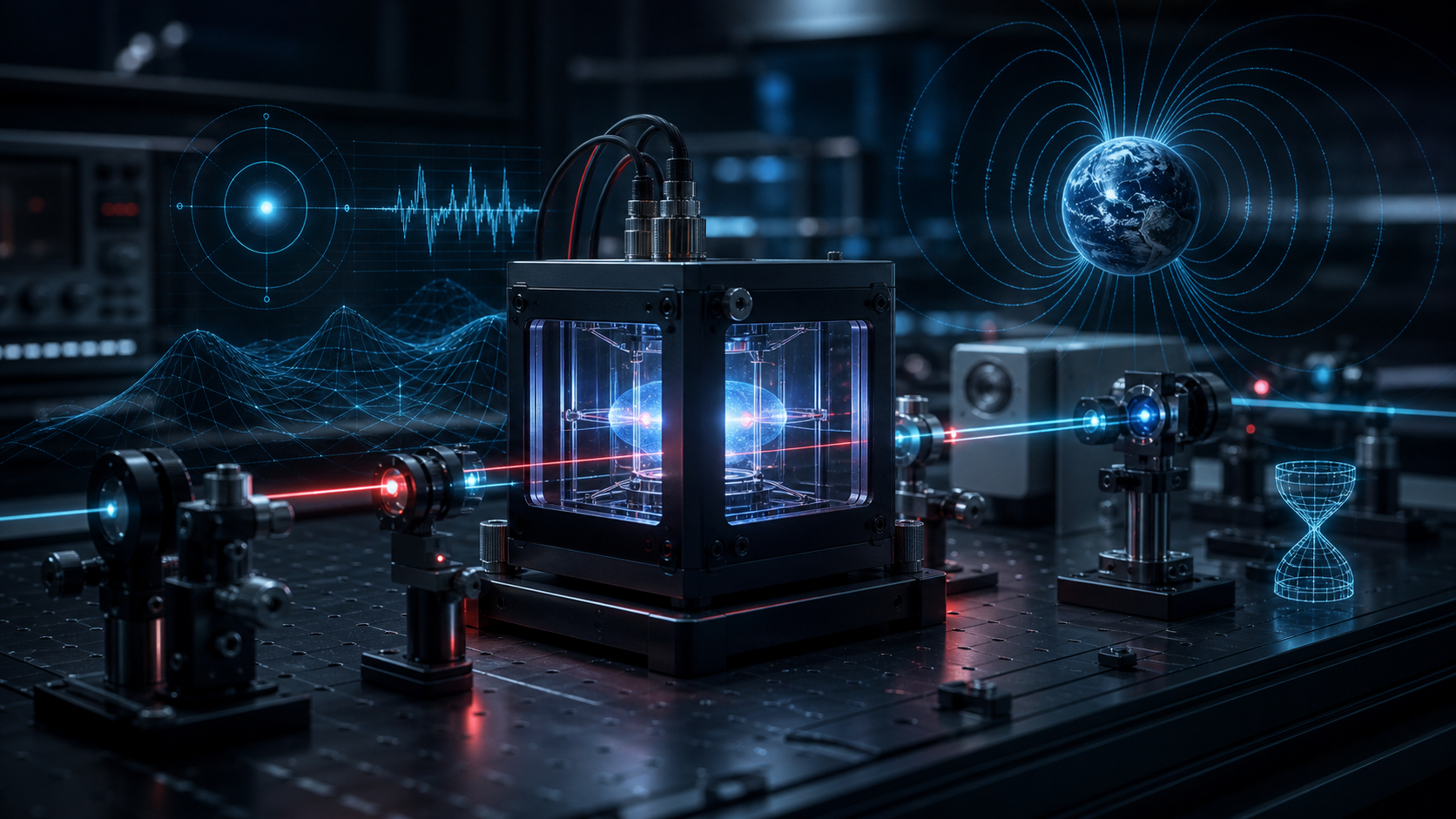
    Useful quantum technology does not begin and end with computers. Quantum sensors use precisely controlled atoms, photons, spins, or superconducting circuits to measure time, gravity, acceleration, magnetic and electric fields, temperature, or light. Some categories already underpin atomic clocks, medical imaging, and scientific instruments, while a newer generation aims for greater sensitivity, smaller size, and operation outside the laboratory.

    These devices may reach practical applications before general-purpose fault-tolerant quantum computers because a sensor performs a narrower job. It does not need to maintain and manipulate millions of error-corrected qubits through a long algorithm. That advantage is real, but it does not make field deployment easy. A sensor sensitive enough to detect a tiny signal may also be extremely sensitive to vibration, temperature, stray fields, and motion.

    What Makes a Sensor Quantum?

    Every physical sensor ultimately follows quantum mechanics, but the term quantum sensor is usually used when a device deliberately exploits a discrete quantum property, coherence, interference, squeezing, or entanglement to make a measurement. The measured signal changes a quantum state, and the instrument reads that change.

    NIST notes that atomic clocks can be considered quantum sensors because they use fixed energy transitions inside atoms as frequency references. Atoms of the same isotope are identical, so the reference does not depend on the dimensions of a manufactured object. This can provide exceptional consistency and a direct connection to fundamental units.

    Atomic Clocks Already Support Everyday Infrastructure

    An atomic clock locks an electronic oscillator to a transition between atomic energy levels. Networks of these clocks support satellite navigation, telecommunications, financial timing, scientific measurement, and national time standards. The user does not carry the most accurate clock; devices receive or compare signals derived from them.

    New optical clocks use much higher-frequency transitions than traditional microwave clocks. Their precision could improve time distribution and help redefine the SI second. They are also sensors for gravity because general relativity makes clocks tick at slightly different rates at different gravitational potentials. Comparing advanced clocks could support geodesy, the measurement of Earth’s shape and gravity field.

    Atom Interferometers Measure Motion and Gravity

    Quantum mechanics lets an atom behave like a wave. In an atom interferometer, laser pulses split, redirect, and recombine atomic wave packets. Acceleration or gravity changes their relative phase, producing an interference signal that can be measured.

    Potential applications include gravimetry, underground structure mapping, inertial navigation, and fundamental physics. A sufficiently stable quantum accelerometer paired with a clock could help a vehicle estimate motion when satellite navigation is unavailable. It would complement inertial systems rather than providing a magic map: small measurement biases accumulate, and an instrument still needs an initial position and careful integration.

    NASA’s Cold Atom Lab on the International Space Station has demonstrated remotely operated atom interferometry in orbit. Microgravity gives atoms longer free-fall times and supports experiments that are difficult on Earth. NASA describes future possibilities in Earth science and fundamental physics, while emphasizing that the work remains a pathfinder.

    Magnetometers Cover Very Different Scales

    Quantum magnetometers detect magnetic fields through their effects on spins or atomic energy levels. Superconducting quantum interference devices, or SQUIDs, are established high-sensitivity instruments. Atomic vapor magnetometers measure changes in optically prepared atoms. Nitrogen-vacancy centers use defects in diamond whose spin state responds to local fields.

    The useful design depends on the application. A diamond sensor can probe magnetic behavior at microscopic scales, while an atomic vapor cell may measure weak fields over a larger volume. NIST’s 2025 review also describes Rydberg-atom sensors, which use highly excited atoms to detect radio-frequency and other electromagnetic fields across a broad range.

    Possible uses include materials analysis, biomagnetic measurement, navigation support, communication metrology, and scientific instruments. Performance claims need bandwidth, dynamic range, spatial resolution, calibration method, and environmental conditions, not only a best sensitivity number.

    Single-Photon Detectors Are Quantum Sensors Too

    A detector able to register one photon is a sensor for the smallest unit of light. Such devices support astronomy, medical and materials measurements, quantum communication, and photonic computing. Superconducting detectors can offer excellent efficiency and timing but require cryogenic systems.

    This area connects directly to photonic quantum computers, which need sources, low-loss paths, and detectors to work as one system. A detector may become commercially valuable in scientific instrumentation long before all those components form a fault-tolerant computer.

    Why Narrow Tasks Can Reach the Field Earlier

    A quantum computer must protect an abstract quantum state while applying a long sequence of operations. Errors compound, making the error-correction challenge central to scaling. A sensor can repeatedly prepare a known state, let a physical quantity change it for a controlled period, measure the result, and average many trials.

    That cycle can tolerate some forms of loss and reset that would destroy a computation. A sensor also produces a conventional number, allowing established electronics and statistics to process the result. Specialized instruments can justify cost and size when they provide a measurement unavailable by other means.

    However, quantum advantage must be demonstrated against the best classical sensor for the same task. A laboratory sensitivity record may disappear once size, weight, power, bandwidth, calibration, motion, and maintenance are included.

    The Main Barrier Is Often the Environment

    Vibration can overwhelm an atom interferometer. Temperature changes move optical components. Magnetic and electric interference can hide a signal. Motion changes alignment and creates acceleration far larger than the subtle effect of interest. Lasers, vacuum systems, cryogenic equipment, and control electronics add their own noise and failure modes.

    DARPA launched its Robust Quantum Sensors, or RoQS, program to address this gap. The program focuses on sensors that maintain performance on moving platforms without relying only on bulky isolation and shielding. Its first phase includes compact sensor development and tests in a dynamic environment. Defense is the immediate use case, but the underlying challenge applies to aviation, ships, vehicles, and field science.

    Miniaturization Is More Than Making the Sensor Head Small

    Chip-scale vapor cells, integrated photonics, compact lasers, and improved packaging can shrink the quantum element. The complete instrument also needs power, control electronics, thermal management, shielding, a user interface, and data processing. Moving complexity into a rack beside a tiny sensor is not full miniaturization.

    Manufacturing repeatability matters as much as size. A useful fleet of sensors needs predictable calibration, service procedures, known aging behavior, and supply chains for specialized components. Integration work can take longer than the first laboratory demonstration.

    Quantum Networks May Extend Sensing

    Entanglement and squeezed states can improve some measurements beyond ordinary statistical limits. Networks of clocks or sensors may compare signals across long baselines for geodesy, astronomy, or searches for new physics.

    Those ideas overlap with quantum networking, but distributed sensing does not automatically require a universal quantum internet. Some systems exchange classical measurement results, while more ambitious designs distribute quantum states. The infrastructure and performance claims should identify which one is actually used.

    How to Read a Quantum-Sensing Claim

    Start with the quantity measured and the baseline instrument. Look for sensitivity per square root of bandwidth, accuracy, precision, drift, dynamic range, sampling rate, spatial resolution, operating temperature, size, power, and performance under motion. Ask whether the result came from a controlled laboratory, a stationary field test, or a moving platform.

    Also distinguish a component from a complete system and a scientific demonstration from an operational product. Quantum enhancement may improve one metric while another requirement sets the real limit.

    What to Watch Next

    Watch portable optical clocks, field-tested atom interferometers, room-temperature atomic magnetometers, integrated single-photon detectors, and results from programs designed around vibration and motion. The most convincing milestones will compare quantum and classical instruments under the same realistic conditions over long periods.

    Quantum sensors are not waiting for a quantum computer to make them useful. They are a separate technology family with existing applications and demanding new ones. Their progress will be measured less by qubit counts than by whether exquisite laboratory measurements become dependable tools.

    Sources and Further Reading

  • Quantum Computing: Why Error Correction Matters More Than Hype

    Quantum Computing: Why Error Correction Matters More Than Hype

    Quantum computing is often described in dramatic language, but the practical story is more disciplined. Quantum computers use quantum bits, or qubits, to represent and process information in ways that may be useful for certain classes of problems. The challenge is that qubits are fragile.

    Small disturbances from heat, vibration, electromagnetic noise, or imperfect operations can introduce errors. That is why error correction is central to the field. Without it, quantum computers remain interesting experimental machines. With it, they may eventually solve problems that are difficult for classical computers.

    What Quantum Computers Might Be Good At

    Potential applications include materials science, chemistry simulation, optimization, cryptography research, and specialized modeling. Quantum computers are not expected to replace ordinary computers for everyday tasks like email, browsing, or spreadsheets. They are more likely to become specialized accelerators for problems where quantum behavior matters.

    The Error Correction Problem

    A useful quantum computation may require many physical qubits to create one reliable logical qubit. This overhead is why headlines about qubit counts should be read carefully. Quantity matters, but quality, connectivity, gate fidelity, control systems, and error correction matter too.

    Progress in quantum computing is therefore a system-level challenge. Hardware, cooling, control electronics, compilers, algorithms, and cloud access all need to improve together.

    How to Read Quantum News

    • Ask whether the result improves logical qubits, not only physical qubits.
    • Look for error rates and benchmark details.
    • Separate research milestones from commercial readiness.
    • Watch quantum sensing and communications, not only computing.

    Quantum technology is real, but timelines are uncertain. The most useful approach is neither dismissal nor hype. It is patient attention to engineering progress.