
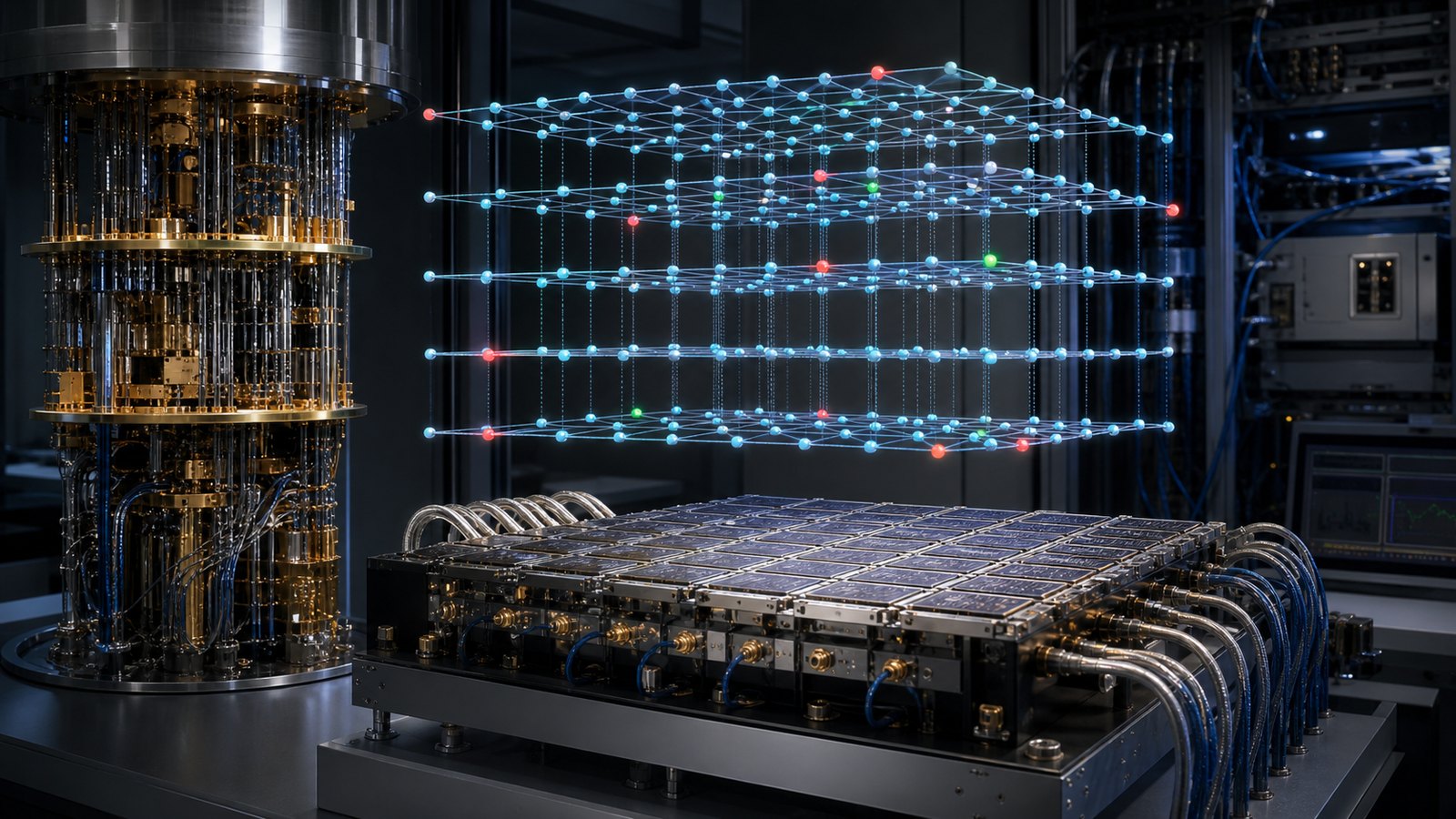
Quantum computers are fragile machines. Their basic units, qubits, can be disturbed by noise, imperfect control pulses, stray heat, measurement errors, and unwanted interactions with the environment. That is why quantum error correction has become one of the most important engineering problems in the field. A useful quantum computer will not be built from perfect qubits. It will be built from imperfect physical qubits arranged so that the system can detect and correct errors faster than they destroy the calculation.
The shift matters because quantum computing is moving from demonstrations of individual devices toward evidence about systems. More qubits are not enough. The question is whether adding qubits can make a logical qubit, a protected unit built from many physical qubits, more reliable than its parts. That is the threshold problem at the center of fault-tolerant quantum computing.
Why error correction is different in quantum computing
Classical computers use error correction everywhere, from storage drives to network links. Quantum error correction is harder because qubits cannot simply be copied and checked directly. Measuring an unknown quantum state generally changes it. Quantum codes therefore spread information across many physical qubits and use carefully designed measurements to detect error patterns without reading out the protected information itself.
The surface code is one of the most studied approaches. It arranges physical qubits into a lattice and repeatedly measures relationships among them. Those repeated measurements produce a stream of clues. A decoder then infers which errors most likely occurred and which correction is needed. This is both a physics problem and a classical computing problem: the quantum hardware must behave well, and the control system must interpret errors quickly.
What below threshold means
In 2024, Google Quantum AI and academic collaborators published a Nature paper reporting quantum error correction below the surface-code threshold. In plain English, that means increasing the code distance, or the amount of redundancy in the logical qubit, reduced the logical error rate in the reported experiment. That is a key milestone because it shows the right scaling direction: more physical resources can buy better protection rather than simply adding more places for things to fail.
This does not mean a general-purpose fault-tolerant quantum computer has arrived. The logical error rates still need to fall dramatically, operations must become more complex, and systems need to run many logical qubits together. But below-threshold behavior is a meaningful sign that error correction is becoming measurable engineering rather than only a theoretical promise.
The hardware stack has to mature together
Error correction depends on the whole stack. Qubits need stable fabrication. Control electronics need precise timing. Cryogenic systems must handle heat and wiring. Software has to schedule operations and decode measurement streams. Calibration must be frequent enough to keep the machine in tune without turning operations into a maintenance exercise.
That is why quantum hardware manufacturing, covered in Quantum Hardware Is Entering Its Manufacturing Engineering Phase, is so closely tied to error correction. A code can tolerate some noise, but it cannot rescue arbitrary hardware instability. It needs errors to be low enough, local enough, and measurable enough for the correction scheme to work.
Roadmaps are becoming more concrete
IBM has framed its quantum roadmap around scaling systems, improving modular architecture, and moving toward fault-tolerant operation over time. Roadmaps should be read carefully: they are plans, not proof. Still, they indicate what major vendors believe the engineering sequence looks like. The field is increasingly focused on logical operations, modular systems, error suppression, error mitigation, and eventually error-corrected workloads.
For readers, the useful distinction is between noisy intermediate-scale quantum devices and fault-tolerant systems. Today’s machines can be scientifically valuable and useful for algorithm research, benchmarking, and hardware development. But a machine capable of long, reliable quantum computations needs logical qubits with much lower error rates. That is the gap error correction is meant to close.
Benchmarks need context
Error-correction results can be hard to compare. Different papers may use different code distances, cycle counts, qubit technologies, decoders, measurement methods, and definitions of logical failure. A headline about a logical qubit is not enough. The important details include how long it was protected, what operations were performed, whether errors were correlated, and whether the method can scale without impossible overhead.
This connects to the broader problem of quantum claims. As we noted in Quantum Random Number Generators Need Certification, Not Just Quantum Branding, the word quantum does not automatically make a product useful. Evidence matters. In error correction, evidence means transparent metrics, reproducible experiments, and progress that survives as systems become larger.
What ordinary users should watch
Most people will not buy a quantum computer. They may eventually use services that depend on one, much as they use cloud computing today. The signs worth watching are therefore infrastructure signs: logical qubits that improve with scale, lower error rates over longer operations, modular links between processors, better cryogenic control, and software tools that can hide some hardware complexity from application developers.
Also watch the classical side of quantum computing. Decoders, control systems, compilers, and verification tools will decide how efficiently physical machines become useful logical systems. The wiring and control problem discussed in Quantum Computers Have a Classical Wiring Problem remains directly relevant.
What to watch next
The next meaningful milestones will not be one-off claims of many qubits. They will be demonstrations of logical operations, multiple logical qubits, lower logical error rates over longer circuits, and architectures that can be manufactured and operated repeatedly. Quantum error correction is not the whole quantum-computing story, but without it, the story probably stays limited.
The sober conclusion is still optimistic. Error correction is starting to look less like a distant abstraction and more like a measurable engineering discipline. That is exactly the kind of progress quantum computing needs.
Sources: Google Quantum AI: Making quantum error correction work; Nature: Quantum error correction below the surface code threshold; IBM Quantum roadmap discussion.
Leave a Reply