
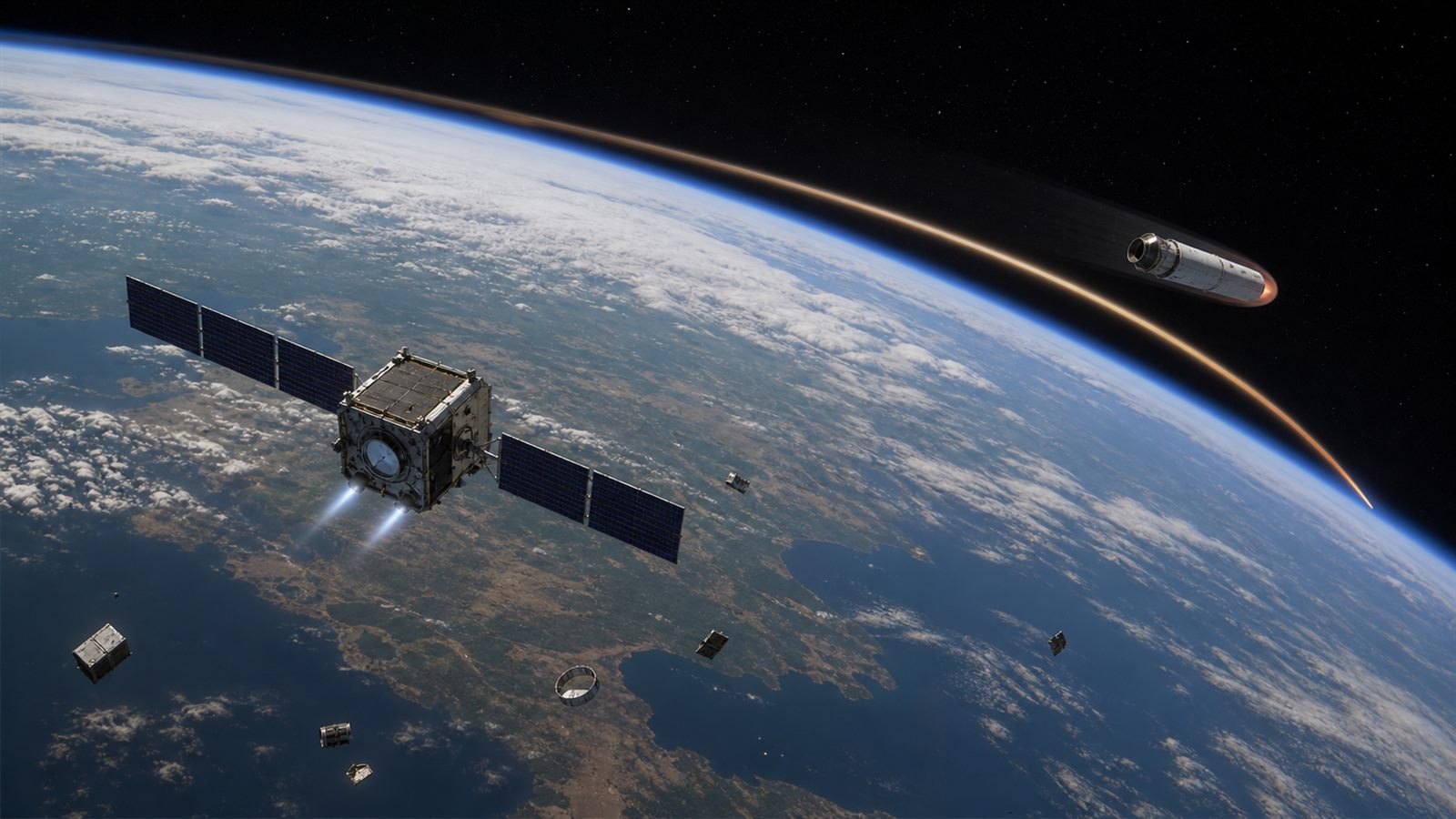
Orbital debris is often presented as a cleanup problem, but the first line of defense starts before a satellite reaches the launchpad. Engineers need to decide how a spacecraft will avoid collisions, prevent explosions, survive small impacts, and leave its operational orbit at the end of its mission. Those choices affect propulsion, batteries, software, fuel margins, communications, testing, and cost.
The urgency is growing. The European Space Agency’s 2025 Space Environment Report says roughly 40,000 objects are tracked in orbit, while models estimate more than 1.2 million objects larger than one centimeter. Most of the smaller population cannot be routinely tracked, yet an impact at orbital speed can disable a spacecraft or create more fragments. Debris mitigation is therefore becoming a normal systems-engineering requirement rather than an optional environmental gesture.
Debris is not only dead satellites
Orbital debris includes retired spacecraft, spent rocket stages, mission-related objects, and fragments produced by collisions or explosions. Size matters, but so does speed. A large object can destroy a satellite, while much smaller fragments can damage solar arrays, sensors, radiators, and pressure vessels.
Different orbital regions present different problems. Low Earth orbit contains many active satellites and objects that may eventually re-enter because of atmospheric drag. Higher orbits can retain debris for much longer. Geostationary spacecraft are normally moved to disposal orbits because atmospheric re-entry is not a practical end-of-life option from that altitude.
Prevention begins with passivation
Many historic fragmentation events were caused by stored energy left in an inactive spacecraft or rocket body. Residual propellant, pressurized tanks, spinning mechanisms, and charged batteries can later trigger a breakup. Passivation means removing or controlling those energy sources when the mission ends.
NASA’s debris mitigation material identifies limiting accidental explosions as a core objective. In practice, that can require valves that vent tanks, commands that discharge batteries, safe configurations for pressure systems, and reliable end-of-mission software. These features need to be designed and tested before launch because repairing them in orbit is usually impossible.
Disposal needs hardware and margin
A disposal plan is only useful if the spacecraft can execute it after years of operation. A satellite may need propulsion, attitude control, power, communications, and flight software to lower its orbit or move to a designated disposal region. Engineers must reserve propellant and account for degraded hardware. Operators also need enough ground support to command the maneuver at the end of the commercial mission.
Shorter disposal timelines can improve the orbital environment, but they raise the reliability bar. ESA has adopted a five-year standard for vacating valuable low Earth orbits for its own activities, while international and national rules continue to evolve. Compliance should be measured by successful disposal, not merely by a plan filed before launch.
Collision avoidance is becoming routine operations
Tracking networks predict close approaches, known as conjunctions, between orbiting objects. Operators then assess uncertainty and decide whether to maneuver. The decision is not automatic: changing course can consume fuel, interrupt a mission, or create a new close approach with another object.
Good coordination requires timely orbit data, reliable contact information, common message formats, and clarity about which spacecraft can maneuver. It also needs automation that helps experts handle a large volume of alerts without blindly accepting every warning. Space weather can complicate orbit prediction by changing atmospheric drag, which connects debris operations to the forecasting infrastructure described in Space Weather Forecasting Is Becoming Critical Infrastructure.
Small debris remains hard to manage
Collision avoidance works best for objects that can be tracked well enough to predict their paths. Much of the dangerous debris population is too small for routine cataloging. Spacecraft may use shielding and component placement to reduce vulnerability, but shielding adds mass and cannot protect against every impact.
This makes fragment prevention especially valuable. One breakup can produce many objects that are difficult to track. Designing tanks, batteries, and structures to avoid fragmentation often delivers more benefit than trying to react to each resulting fragment later.
Active removal may be necessary
Mitigation prevents new debris; remediation addresses large objects already in orbit. ESA’s 2025 report concludes that even with no additional launches, fragmentation could keep increasing the debris population, so active removal is needed for long-term stability. Large abandoned objects are attractive targets because a collision involving one could create many fragments.
Removal is technically and legally difficult. A servicing spacecraft must approach and capture an object that may be tumbling and was not designed to be handled. Ownership and liability remain with the launching state, so permission matters. The docking and interface problem relates directly to Satellite Servicing Needs Standard Interfaces Before It Can Scale. Future satellites designed with grappling fixtures could be easier to service or remove.
Rules are becoming part of mission economics
Licensing authorities increasingly ask operators to describe debris mitigation, collision risk, casualty risk from re-entry, and post-mission disposal. Insurers, launch providers, and customers may also care about compliance. This moves sustainability from a public promise into mission documentation and engineering reviews.
There is still a risk of paper compliance. An optimistic reliability estimate cannot replace flight-proven hardware, sufficient fuel, and continued operations funding. Constellations magnify the issue because a small individual failure rate can leave many satellites stranded when repeated across a large fleet.
Limitations and tradeoffs
Deorbit maneuvers consume fuel that could otherwise extend a mission. Lower operational orbits may reduce debris lifetime but increase atmospheric drag and station-keeping needs. Controlled re-entry can reduce risk on the ground but demands propulsion and tracking. Moving spacecraft to a disposal orbit prevents interference with an operational region but does not remove the object from space.
Debris mitigation also cannot be separated from communications and navigation. The lunar network discussed in Why the Moon Needs Its Own Communications and Navigation Network will need sustainability rules before traffic around the Moon becomes crowded. The engineering habits developed in Earth orbit should travel outward.
What to watch next
Watch for verified disposal success rates, standardized passivation reporting, better tracking of smaller objects, interoperable conjunction messages, and contracts for active debris removal. Also watch whether regulators align on shorter post-mission timelines and how they handle spacecraft that lose propulsion or contact.
The most effective debris mission may be the one that never becomes necessary. Designing satellites to avoid breakups, maneuver safely, and dispose of themselves is cheaper and more predictable than cleaning up fragments after a collision. Orbital sustainability is becoming an engineering discipline because the shared environment leaves no room for every operator to treat disposal as someone else’s problem.
Sources: ESA Space Environment Report 2025; NASA Orbital Debris Program Office: Debris Mitigation; NASA Procedural Requirements for Orbital Debris Mitigation; Inter-Agency Space Debris Coordination Committee guidelines.
Leave a Reply