
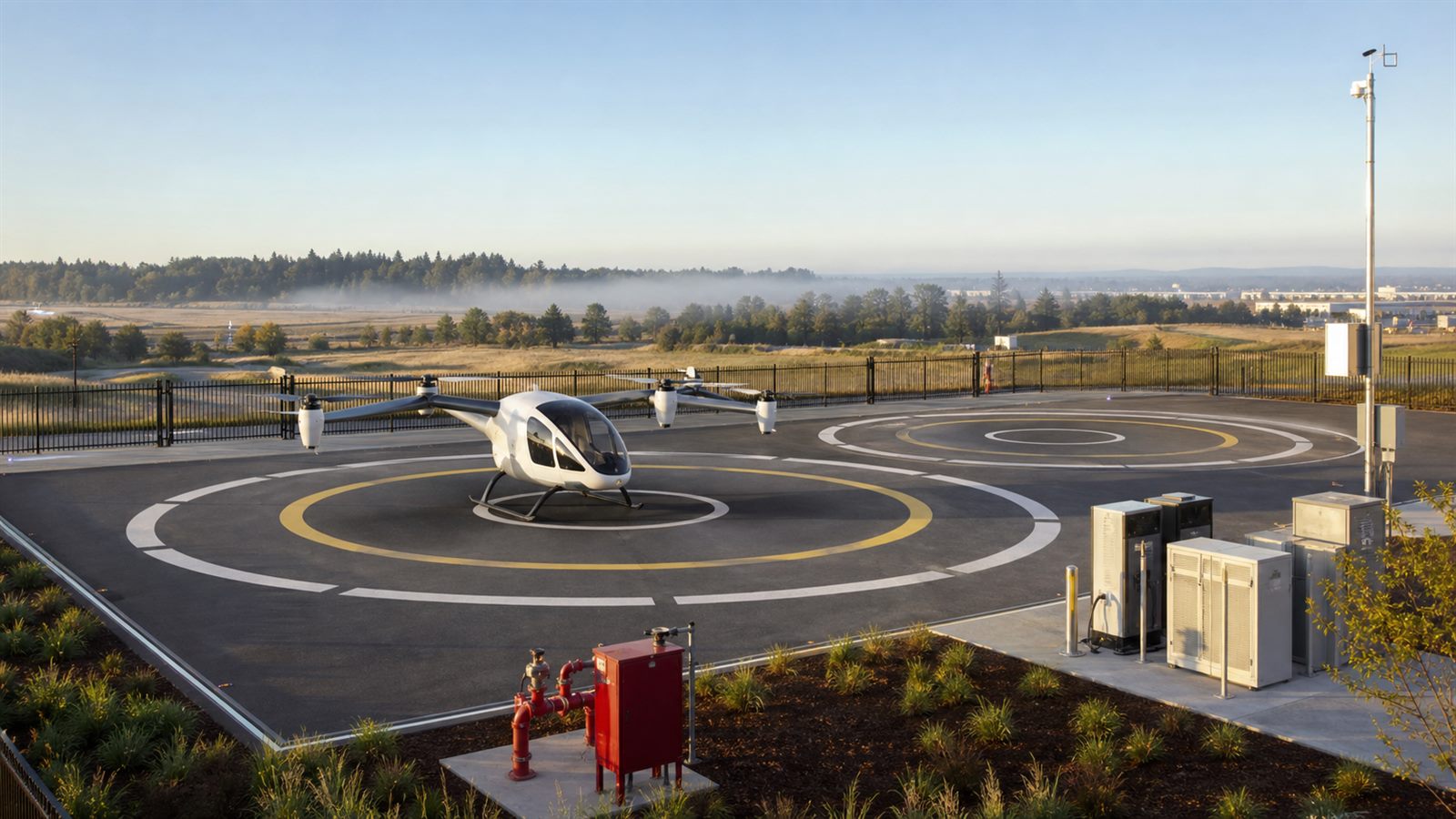
Electric vertical-takeoff aircraft are usually photographed in flight, but their commercial future may depend just as much on the ground. A vertiport needs safe approach paths, landing areas, passenger handling, charging or fueling, firefighting access, weather data, power capacity, and integration with existing airspace. Building a small aircraft is not the same as building a transport system.
Regulators in the United States and Europe are now turning that infrastructure into concrete guidance. The Federal Aviation Administration’s Engineering Brief 105A covers public and private vertiports, including new sites and modified helicopter or airplane facilities. The work shows why an air-taxi network cannot simply place landing pads on convenient rooftops and begin operating.
A vertiport is more than a painted circle
The FAA defines a vertiport as an area of land, water, or structure intended to support the landing, takeoff, taxiing, parking, and storage of powered-lift or other compatible aircraft. The landing surface is only one part of the facility. Designers need a touchdown and lift-off area, a larger final approach and takeoff area, safety areas, clear paths, lighting, markings, and access for emergency response.
The reference aircraft matters. Rotor layout, wingspan, weight, landing gear, downwash, and failure behavior affect pad dimensions and separation. EB 105A is focused on a defined early operating case, including piloted aircraft in visual meteorological conditions. The FAA describes it as a living document that can change as validated aircraft data becomes available.
Approach paths shape the site
An aircraft needs a path into and out of the facility that avoids buildings, towers, cranes, and other obstacles. That can rule out sites that look attractive on a map. The FAA’s existing airport notification and airspace-study requirements also apply to proposed vertiports, so developers must consider the surrounding National Airspace System rather than only the property boundary.
EASA’s vertiport guidance introduced an obstacle-free volume above the site, reflecting the vertical portion of some VTOL approaches. The concept gives planners a way to evaluate buildings and trajectories around dense urban sites. It also exposes a central limitation: a rooftop can have enough physical space for a pad while lacking a safe and repeatable approach corridor.
Downwash and outwash affect people and buildings
Multiple propellers can produce strong, complex airflows near the ground. Downwash strikes the surface and spreads outward as outwash, potentially moving loose objects, damaging equipment, or affecting people outside the pad. The flow can interact with walls, rooftop edges, nearby aircraft, and intake or exhaust systems.
Designers therefore need aircraft performance data rather than generic assumptions borrowed from one helicopter. Fencing, setbacks, surface materials, drainage, snow, dust, and maintenance procedures may all be influenced by rotor flow. A facility that is safe for one aircraft configuration may not automatically be safe for another.
Electric charging becomes airport infrastructure
Fast aircraft turnaround can demand substantial electrical power. A vertiport may need new utility service, transformers, switchgear, chargers, cooling, backup power, and controls that coordinate charging with flight schedules. The connection process can take longer than installing the pad itself, especially where the local grid has limited capacity.
Operators also need to plan for battery isolation, thermal events, damaged aircraft, and emergency access. Charging equipment should not block evacuation or firefighting routes. The infrastructure challenge resembles the one facing heavy vehicles in Megawatt Charging Is More Than a Bigger Plug for Electric Trucks: the connector is only one part of a system that includes power delivery, heat, operations, and safety.
Certification extends beyond the aircraft
The FAA’s powered-lift final rule established a framework for pilot qualifications, instructors, and operating requirements. That was necessary because powered-lift aircraft combine characteristics of airplanes and helicopters. Aircraft certification, pilot rules, operating approvals, and vertiport design must progress together before routine passenger service can scale.
This is why certification evidence matters more than ambitious launch dates. The same lesson appears in Electric Aircraft Need Certification Progress More Than Battery Hype. Range and speed are useful specifications, but regulators also need evidence about failure modes, continued airworthiness, training, maintenance, and emergency procedures.
Airspace capacity may limit network capacity
A vertiport cannot schedule unlimited arrivals and departures. Aircraft must be separated from each other and from conventional traffic. Weather can reduce available routes. Noise restrictions may limit operating hours, while missed approaches and diversions need safe alternatives.
Dense operations will require traffic management, communications, surveillance, and predictable procedures. Early services are likely to be more constrained than illustrations showing many aircraft moving freely between buildings. A useful network may begin with selected routes and existing airport connections rather than a pad on every block.
Passenger experience is an operational system
Even a small facility needs secure access, identity checks appropriate to the service, boarding control, accessibility, baggage rules, and protection from weather. Passengers must be kept away from moving rotors and energized equipment. The time saved in flight can disappear if ground processing is slow or the vertiport is poorly connected to streets and public transport.
Emergency planning also needs more than an evacuation sign. Operators must consider an aircraft that cannot use its intended pad, a charger fault, a battery incident, severe weather, or a power outage. Repeatable drills and clear responsibility between the operator, fire services, utility, and air traffic organizations will be part of safe scaling.
Community acceptance is infrastructure too
Noise, visual impact, traffic, privacy, and land use will shape where vertiports are allowed. Electric propulsion can reduce some noise sources, but it does not make aircraft silent. Repeated operations may be more important to neighbors than the sound of a single demonstration flight.
Public evaluation should use measured noise and realistic flight schedules. It should also compare an air-taxi route with other transport investments serving the same trip. Regulatory testbeds, discussed in Automated Driving Testbeds Are Becoming Part of the Regulatory Infrastructure, offer a useful model: controlled operations can reveal how technology, rules, and human behavior interact before wide deployment.
Limitations worth keeping in view
FAA and EASA guidance does not guarantee that a particular business model will work. Aircraft still need certification, operators need approvals, and sites need local planning permission. Energy prices, maintenance, utilization, weather, and passenger demand will determine economics. A technically compliant vertiport may still be in the wrong location.
Standards will also evolve as operational data grows. Early facilities should avoid design choices that prevent adaptation to different aircraft sizes, charging systems, or safety requirements. Modularity and reserved utility capacity may be more valuable than an architecturally dramatic terminal.
What to watch next
Watch for certified aircraft paired with approved operating rules and completed vertiports, not isolated announcements. Useful milestones include validated downwash data, utility interconnection agreements, emergency-response standards, measured community noise, and trial operations connected to the existing transport network.
Vertiports are where advanced air mobility meets ordinary infrastructure. They turn an aircraft concept into a system that cities, utilities, regulators, emergency services, and passengers must all be able to use. The air taxi may attract attention, but the ground network will decide whether it becomes transport.
Sources: FAA Engineering Brief 105A: Vertiport Design; FAA: Advanced Air Mobility Infrastructure; FAA powered-lift pilot certification and operations final rule; EASA vertiport design specifications.
Leave a Reply